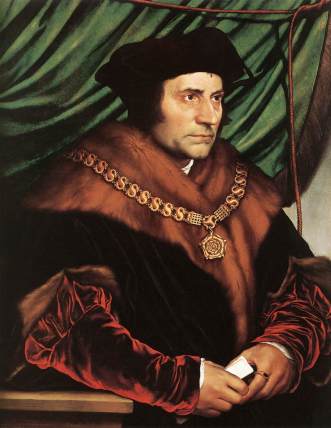
Thomas More, Martyr of Traditional Marriage: Part Two—His Time, and Ours

Thomas-More-and-Family

In late polyphonic music the central aspect is the delicate interplay of voices without any single one of them taking precedence. In music of a century later we find the dramatic use of a powerful individual voice, but in fifteenth-century English polyphone the emphasis rests upon the intricate melody of many voices. The character and abilities of the individual are only of consequence as an element within the harmonious organization of parts; we do not know the names of the masons who created the bell towers and fan-vaults of the great fifteenth-century churches. This is not the world of Luther or of what has become known as post-Reformation culture, but it remained the world of Thomas More.

From Thomas More, by Peter Ackroyd

In this essay, I hope to trace some parallelisms between the moral shifts in Thomas More’s day and those in ours. The comparisons are, of course, imperfect. But I think they are also significant. Continue reading

Mistaking Love: what is not love

what-is-love2

In my last article I wrote about how marriage ought to be painful because it means that two separate wills are trying to function together. If there is no strife in a marriage one might assume the couple is quite lonely:

The loneliness is straightforward. A child who has captured the imagination of other children soon seems to be playing a game with himself—his own imagination reflected back at him from the other children. Likewise, when the one I love becomes a means to fulfilling my own desires, they take on the image of a mirror. And there is loneliness: a lack of the other person—a lack of another’s will and desire that stands against my own.

I would like now to elaborate on this concept Continue reading

Why a Marriage Ought to be Painful

marriage-breakdown-544741

Over the last week my wife Sarah and I have moved to a new state, got an apartment, began to wage a war against cockroaches, went thrift store shopping to any number of places to try and find decent furniture that won’t give us lice, bought a new mattress, carried many heavy objects through ridiculous humidity, built a bed frame to save a few dollars, etcetera. Stress levels have been high and my wife and I were more than a few times upset with each other, which only makes everything more miserable, which only makes me more upset that we’re upset because things are bad enough as it is, which makes me more miserable, which makes me more upset, and so forth. At moments of resentment, for whatever silly reason, rather than a helpmeet, Sarah has felt like an inconvenience, and I know Continue reading

Abortion: Our Renewed Monstrosity

I just finished reading The Good Earth, a portrayal of thousands of years of ancient Chinese history wrapped up in the life of one man. Wang Lung is a father and farmer living in a world of tradition, superstition and blunt mortality, whose existence revolves around the dispassionate but life-giving land. Pearl S. Buck writes,

“There was only this perfect sympathy of movement, of turning this earth of theirs over and over to the sun, this earth which formed their home and fed their bodies and made their gods . . . Some time, in some age, bodies of men and women had been buried there, houses had stood there, had fallen, and gone back into the earth. So would also their house, some time, return into the earth, their bodies also. Each had his turn at this earth. They worked on, moving together— together— producing the fruit of this earth.”

The land is both nurturing and uncaring, life-providing and destroying. It exists beyond the little lives and little centuries. What in Modernity compares; how can we understand with our tiny first world problems and contingency-sparse existence? Yet as one reads, the vitality of the land imprints like a footprint in the soil of a freshly turned mind; one can feel one’s sympathies and world view shifting and even temporarily settling into an ancient order of life, of death, of birth. It is somehow familiar to some primal ancestral self, still stirring in the blood from ages ago.

Continue reading

Dear Presidential Candidate – I believe in the Constitutional Convention

Dear Presidential Candidate,

I watched the Republican debate earlier this month. Their rhetoric (like that of other parties) often riffs on the claim, “I believe in the Constitution.” What that actually means is somewhat harder to express in a soundbite. As with all historical texts, our understanding of what it means is not as straightforward as we might like to think—it is based on conjecture of authorial intent, interpretation of judicial precedent, and appeals to implicit ideals. This is not to say that we should ignore the actual text of Constitution, but I think recognizing the complexity of constitutional law can help us tolerate and even collaborate with those who interpret it differently. Continue reading

Thomas More, Martyr of Traditional Marriage: Part One—His Greatness and His Values

After watching BYU’s production of “A Man for All Seasons,” a play about Thomas More, I was so inspired that I ordered Peter Ackroyd’s biography of the man. I finally finished it this summer, having worked my slow way through it mostly on Sunday afternoons during the last two years. (Law school has left little time for extra reading.) Although the play “A Man for All Seasons” portrays him, in some ways, more heroically than he deserves, I find that the true facts of his life and death are altogether more inspiring than the play—though I strongly recommend both. (And by the way, the play has been made into an excellent movie of the same title that won six academy awards in 1966, including best picture. Go watch it.) This first essay will be primarily an encomium on Thomas More, though I will depart far enough from my subject to contrast his values with the predominant moral sensibility of our day. In part two, I hope to compare the moral shift that society underwent in More’s day with the shift that has taken place in ours. I have made no secret of the fact that I am opposed to gay “marriage,” and this is part (but only part) of what motivates me to write—for More was, so far as I am aware, the first martyr who can be said to have died, in part, for traditional marriage. Continue reading