Dear Presidential Candidate – I believe in the Constitutional Convention

Dear Presidential Candidate,

I watched the Republican debate earlier this month. Their rhetoric (like that of other parties) often riffs on the claim, “I believe in the Constitution.” What that actually means is somewhat harder to express in a soundbite. As with all historical texts, our understanding of what it means is not as straightforward as we might like to think—it is based on conjecture of authorial intent, interpretation of judicial precedent, and appeals to implicit ideals. This is not to say that we should ignore the actual text of Constitution, but I think recognizing the complexity of constitutional law can help us tolerate and even collaborate with those who interpret it differently. Continue reading

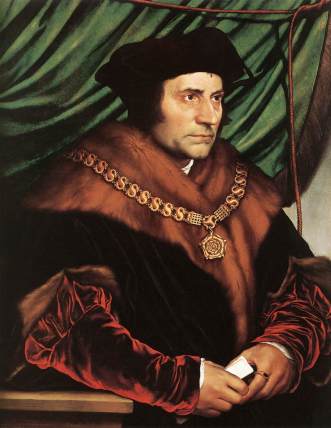
Thomas More, Martyr of Traditional Marriage: Part One—His Greatness and His Values

After watching BYU’s production of “A Man for All Seasons,” a play about Thomas More, I was so inspired that I ordered Peter Ackroyd’s biography of the man. I finally finished it this summer, having worked my slow way through it mostly on Sunday afternoons during the last two years. (Law school has left little time for extra reading.) Although the play “A Man for All Seasons” portrays him, in some ways, more heroically than he deserves, I find that the true facts of his life and death are altogether more inspiring than the play—though I strongly recommend both. (And by the way, the play has been made into an excellent movie of the same title that won six academy awards in 1966, including best picture. Go watch it.) This first essay will be primarily an encomium on Thomas More, though I will depart far enough from my subject to contrast his values with the predominant moral sensibility of our day. In part two, I hope to compare the moral shift that society underwent in More’s day with the shift that has taken place in ours. I have made no secret of the fact that I am opposed to gay “marriage,” and this is part (but only part) of what motivates me to write—for More was, so far as I am aware, the first martyr who can be said to have died, in part, for traditional marriage. Continue reading

What do George Lucas, Peter Jackson, and Steve Jobs have in common?

starwars

After seeing the final iteration of The Hobbit saga, my wife joked with me that Peter Jackson must have called George Lucas for advice—think about it. Who else would you ask about how to make a second trilogy that was actually a prequel to the first trilogy but had a younger audience demographic in mind? I mean, imagine the conversation:

“The first thing you have to realize, Peter, is that your fan base in finicky and won’t want more of the same. To keep their interest you’ll have to add more spectacle, less plot, a few cartoony characters, and a contrived love story with horrendous dialogue developed between action sequences. Continue reading

How Should we Study the Bible?

moby

I have recently been working on creating an interfaith and interdisciplinary study Bible with the goal of broadening our approach to the good book. The project would allow readers to gather any relevant video, literature, art, music, et cetera, around passages of scriptures—anything from graffiti to Talmudic commentary. I began the project because I believed and still believe it could be an important step in interfaith dialogue as well as a way to revitalize the Bible from what I believe may be a tragedy of our time: the division of the spiritual and secular worlds. For a thousand years the Bible has been at the center of life, culture, education, art, philosophy, and science. It inspired Dante, Spencer, Milton, Wordsworth, Dickens, and Dostoyevsky to name just a few authors. But now it is increasingly becoming a shield situated between the spiritual self and that dreaded secularization—or the world outside of religion. While this bifurcation helps to maintain Christian identity, I’m not convinced it is the most productive use of scripture. Continue reading

Thoughts on Teacher Preparation (Part 2)

The most common conceptualization of what happens when we learn is some version of inputting: We imagine that learning involves taking something located outside of our brain and bringing it inside. Though intuitive, this conceptualization of the learning process is problematic. This is the way that many teachers think about student learning, and it is also the way that teacher preparation programs approach the learning of prospective teacher’s. Indeed, this philosophy of teacher preparation may actually be at the root of our failure to adequately prepare teachers for the demands of the profession. I intend to explain why I think this is so, and offer an alternative model of learning that seems to me less problematic and more promising.

When prospective teachers enroll in a teacher preparation program, usually at a university’s school of education, they take courses where they learn about educational psychology, curriculum design, and teaching methods. All of this is generally interesting and potentially valuable. However, this inputting, though arguably necessary, is not sufficient. Once teachers enter a classroom, Continue reading

Reply to Equality is NOT a False Ideal

lady-justice

Here is my reply:

Thank you so much for your thoughtful response, Rob. Our blog desperately needs dialogue with differing views–both for balance and for interest. And all of us desperately need dialogue with differing views for mere sanity. That said, though, I agree with much of what you say here. But I still maintain that equality should not be considered an end in itself.

My goal with this essay was not to argue that equality is never proper or good or even requisite. It sometimes is all of those things. My goal was to show that it is never the fundamental good that is at issue in any context, and that it is illegitimate to think of it as a fundamental good. My description of it as “a false ideal” may be a little strong, but the strong formulation is intended to grab the attention.

What do I mean by a “fundamental good”? I would say that there are two types of fundamental goods Continue reading