Ambiguity and [Un]healthy Sexuality in the World and in the Church [4]

PART 4: UNHEALTHY SEXUALITY IN THE CHURCH

While the World’s sexuality belongs properly to hell, the Church is too often caused to lift up its eyes in torment because of sexual guilt. If sexuality’s main effect in one’s consciousness is to cause guilt, it is not healthy, albeit still preferable to the drunken sexuality that is past feeling the tug of morality.

I have previously defined the Church broadly enough to encompass any religion that recognizes that God rightfully regulates human sexuality, and I assume that the experience of the practitioners of other religions is comparable. But I do not actually know that, and for the remainder of this essay, the Church will refer more specifically to the Church of Jesus Christ of Latter-day Saints, where I know from personal experience and by report that the problems I identify are not uncommon. I will designate this as the (lower case “c”) church.

The prevalence of excessive sexual guilt is understandable, especially given the toxic cultural environment in which the church operates, where sexual desire is intentionally and incessantly stimulated by advertisers, media, and peers alike. Lucretius once theorized that the male sexual response to the visual stimulus of female bodies is a strictly automatic, glandular event. While I can positively affirm that this oversimplifies the matter, I see where he was coming from. It is perhaps strictly impossible for most men to avoid being attuned to the sexual. It is interesting as well as fraught—an object of curiosity as well as desire. While a man may be enabled to choose a chaste response to a beautiful woman immodestly advertising her availability, he cannot choose indifference. And yet those who align with the church are taught that they must not intentionally stimulate or condone the intentional stimulation of sexual feelings in their own bodies or those of anyone else except within marriage—and even then only when it edifies. Anything outside this context violates the law of chastity. Continue reading
Ambiguity and [Un]healthy Sexuality in the World and in the Church [3]

PART 3: UNHEALTHY SEXUALITY IN THE WORLD

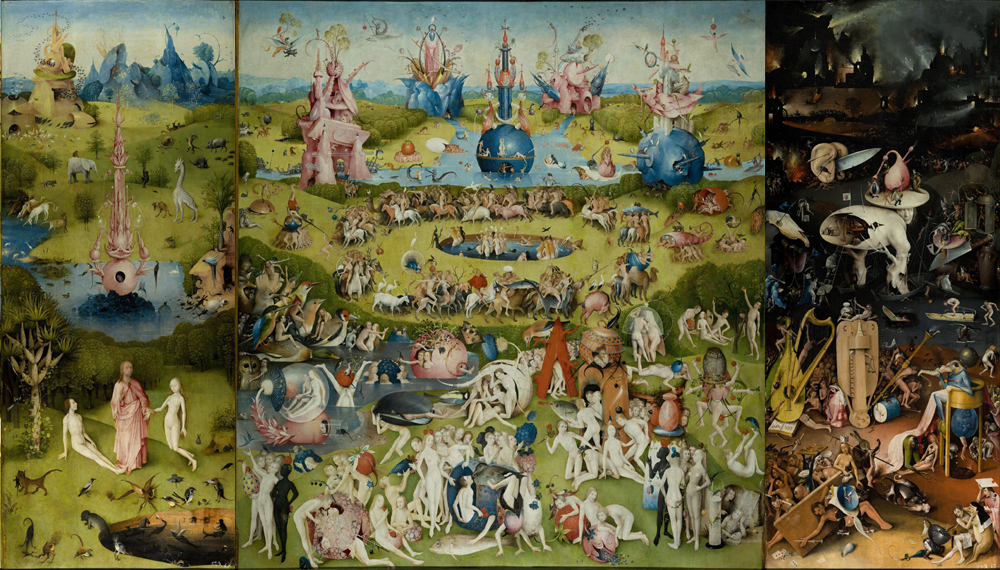
Hieronymus Bosch, Garden of Earthly Delights (triptych), c.1515

“The World” here is defined in contradistinction to “the Church.” The fundamental difference for present purposes is that the Church recognizes the authority of God’s commandments respecting sex while the World follows its desires regardless of God’s commandments. People do not divide neatly in the World and the Church, but at the same time the distinction is more than theoretical. I am sure that there are atheists who eschew sexual whateverism and, for their own reasons, promote faithfulness within loving dual gendered marriage as the only ethical expression of sexuality; but I cannot think of a single person I actually know who fits this category today. The vast majority of those who remain unmoved by the sexual and ideological revolutions of the last century are the religious–and most major religions (including at least Hinduism, Christianity, Islam, Sikhism, and Judaism) have historically spoken with virtual unanimity on the subject. Buddhism, of course, considers liberation from all desire and attachment the ultimate goal, and it therefore has perhaps an even less permissive stance towards sexuality than the other major religions.

While the nearly unanimous consensus of the world’s major religions is so strong an argument in favor of traditional sexual morality as to be, in my judgment, very nearly conclusive, I do not insist on traditional sexual morality for present purposes. What I insist on is that people must attempt to comply with a moral and philosophical system that is dictated by reason and conscience and not by desire. Desire must bow to Right (“as God gives us to see the right”), not Right to Desire. To the extent that a rigorous and conscientious atheist regulates his sexuality by the morality that seems to him correct and yet denies the authority of God’s purported commandments, he is outside the Church but also outside the World. Continue reading

AMBIGUITY AND [UN]HEALTHY SEXUALITY IN THE WORLD AND IN THE CHURCH [2]

PART 2: WHAT IS A HEALTHY SEXUALITY?

monument, statue, horse, sculpture, london, art, illustration, roman, lance, chariot, force, tunic, greatness, run away

Plato’s Republic gives what I think is a true pattern of “healthy” humanity, although I disagree with him on certain details. The true pattern is that each part fits within a harmonious whole and plays its proper role. For him, this means that the belly (symbolic of the lower passions such as hunger and sex) and the heart (symbolic of the higher passions like ambition and patriotism) are both under the direction and control of the mind, the seat of pure reason, which itself serves the Good.

Strongly influenced by Plato, Augustine holds out a similar pattern: our loves must be correctly ordered, with love of God most dominant and everything else falling into order below that.

Plato and Augustine both depend on some highest entity as an ordering principle: reason/the Good or love of God. Here, if I want to say anything that will apply to both the “Church” and the “World,” irrespective of one’s worldview, I cannot assume any consensus about what that highest entity is. For the health of the full person, we do, in my opinion, require higher commitments than mere desire to inform and order our lives. For purposes of this essay, I will simply posit that whatever the ordering principle or set of principles, our sexuality should fit within the whole as a contributing and harmonious part. That does not mean that there can be no remainder after subtracting out sexuality’s contribution to the ordering principle. But the remainder, if any, must not sabotage the ordering principle. Thus, healthy sexuality entails a moral system that regulates sexuality. Continue reading

A Modified Theory of the Atonement: God’s Response To The Human Condition

File:Edvard Munch - Golgotha (1900).jpg
Edvard Munch, “Golgotha”

Because we could not come to him or even be brought to him without horror, he came to us, in the form of Jesus Christ. There was never a time when God had not yet intervened in the human condition, so it is misleading to conceptualize the sending of his son as the beginning of God’s response. But Jesus Christ, from before the foundations of the earth, is the ultimate expression and the primary vehicle of God’s intervention. He is “the anointed one”–the “Christ” (in Greek) or “Messiah” (in Hebrew)–the one chosen to serve as this vehicle. As in all of the great hero stories, the hero comes prepared with the necessary assets for the monumental task that is set before him. Often the hero is told of some weakness of the enemy and given a predestined weapon, tempered for the conflict. The hero of God and man came armed, not with any sword of destiny, but with an intimate and unbreakable relationship with his Father. He spoke unceasingly of his Father–from his first recorded utterance (“Wist ye not that I must be about my Father’s business?”) to his dying breath (“Father, into thy hands I commend my spirit.”). Why did he have power to perform miracles? Because his Father showed him how and gave him power. “Verily, verily, I say unto you, The Son can do nothing of himself, but what he seeth the Father do” (John 5:19). “All things are delivered unto me of my Father” (Matt 11:27). “The Father loveth the Son, and hath given all things into his hand” (John 3:35).

Continue reading

A Modified Theory of the Atonement: The Human Condition

Photo Credit: https://www.flickr.com/photos/28722516@N02/3277796079/

The Human Condition In One Sad Story

If the Atonement was the completion of a task necessary for man’s reconciliation with God and with his fellow man, then we need to first understand the nature of the breach that the Atonement was meant to heal. If the “good news” of the Gospel is salvation through Christ, we need to comprehend what he saves us from before we can speculate about what metaphor best expresses how he accomplished it. 

My cousin saw a young man from his high school walking on the side of the road, and he felt he should pull over. My cousin was a successful scholar, athlete, and member of the student government, well-liked and looked up to by many of his peers. This young man was at the opposite end of the popularity spectrum. He was occasionally bullied and constantly given reason to understand, through subtle exclusions and other signs familiar to most of the high school population, that he was not “cool” or “successful.” My cousin, for his part, had tried to be nice to this young man, as to everyone else, by such simple kindnesses as saying hi with a smile before class started. My cousin thought he seemed dejected and wanted to offer a ride, but then thought, “I hardly know this guy. It would be weird for me to offer him a ride. Besides, I will already be up late doing my homework.” So he ignored the generous impulse and kept on driving. He got to school the next day and found out that the young man had died the evening before by suicide. Continue reading

A Modified Theory Of The Atonement: Why Modify?


The apparent illogic of the notion of God suffering for man’s sin is captured nicely in “Life of Pi”:

Humanity sins but it’s God’s Son who pays the price? I tried to imagine my Father saying to me, “Piscine, a lion slipped into the llama pen today and killed two llamas. Yesterday another one killed a black buck. Last week two of them ate the camel. The week before it was painted storks and grey herons. And who’s to say for sure who snacked on our golden agouti? The situation has become intolerable. Something must be done. I have decided that the only way the lions can atone for their sins is if I feed you to them.”

“Yes, Father, that would be the right and logical thing to do. Give me a moment to wash up.”

“Hallelujah, my son.”

“Hallelujah, Father.”

While the character who finds the story of Christ’s Atonement so illogical does eventually find it meaningful and valuable, he does not resolve the illogic. And that is fine for a character who appreciates Christianity, in common with every other religion, as a set of beautiful stories that contain truth. But for a person like me, who considers Christ himself to be the Truth and Christianity to not only contain truth but to be true, the apparent illogic grates on the mind. Continue reading