
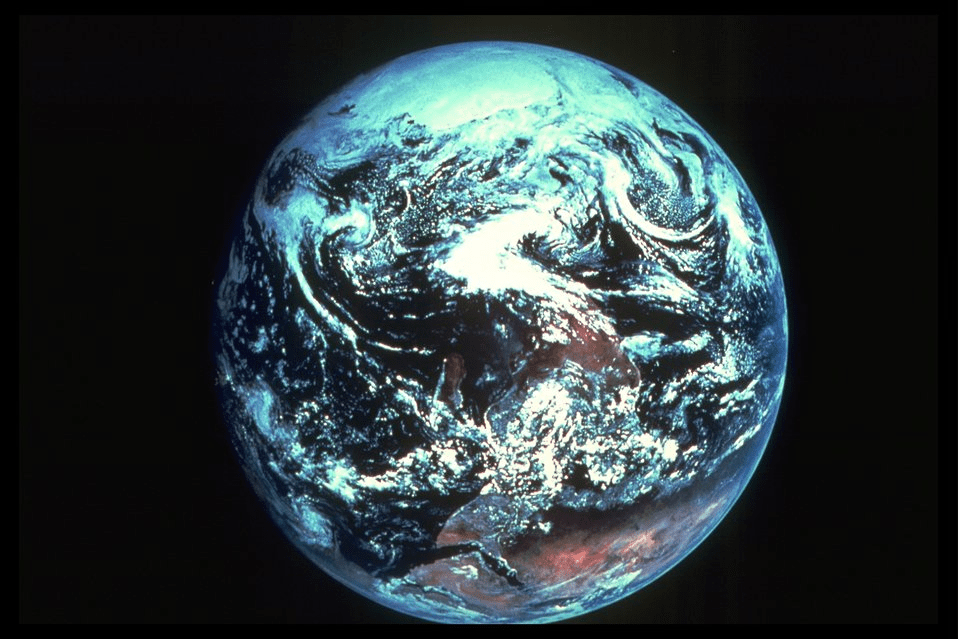
Genesis 1:1-2 In the beginning God created the heaven and the earth. And the earth was without form, and void; and darkness was upon the face of the deep. And the Spirit of God moved upon the face of the waters.
I am no Hebraist, but I have learned a little about the Hebrew in these first two verses. The word for “God” throughout Genesis 1 is “Elohim,” a plural noun more accurately rendered as “Gods.” The Hebrew word rendered as “Spirit” means, at one and the same time, spirit, wind, and breath. More mysterious is the word rendered as “moved” in the KJV. (“The Spirit of God moved upon the face of the waters.”
That word is “Merakhefet” – the root verb “RHF” is a feminine, present tense participle. In English, our verbs don’t have gender, but a present tense participle is a verb that ends with “ing.” Scholars have only a vague idea of what “merakhefet” means. It appears only two other times in any ancient Hebrew writing, both in the Old Testament. One has to do with the trembling or shaking of Jeremiah’s bones in response to the Word of Jehovah.
More helpful for understanding Genesis 1:2 is the only other passage of ancient Hebrew to use the verb, in Deuteronomy 32:10-11.
He found [Israel] in a desert land,
in an empty, howling wasteland.
He surrounded them and watched over them;
guarded them as the apple of his eye.
As an eagle stirs up its nest,
hovering over its young . . . .
So the imagery here is of a mother eagle. As she is to her nest and her eaglets, so is God to Israel. The word rendered as “hovering” is merakhefet.
So turning back to Genesis 1:2, an alternate translation would be that the Gods’ breath-spirit was hovering, nesting, brooding, or fluttering over the deep.
When a mother bird incubates her eggs, she is imparting her own vital heat, the warmth generated by her life. A little later in the Genesis account, God breathes life out of himself and into Adam. That is profoundly analogous to what the Spirit is doing in Genesis 1:2.
This maternal hovering, brooding, or fluttering of the Gods’ breath-spirit is the first act of creation. With each subsequent act, the earth and heavens are organized towards bringing forth life, and then higher forms of life, until man is created. It’s as though the gods impart to the proto-Earth some of their own maternal power, making it into a Mother Earth, and they direct first her own evolution and then the evolution of her children ever upward, ever closer to their own life, until Mother Earth brings forth a species in their own image.
Each creature is born with some implicit directives. Whether through evolution and genetics or otherwise, God has hardwired these directives into every species: live, have joy, fulfil certain purposes or meanings, and multiply.
During the creation process, the Gods repeatedly survey the creation, and they see that it is good. After man is on the earth, they see that it is “very good.”
At this point in the scriptural chronology, there was no moral opposition and therefore no righteousness and no wickedness. In the absence of righteousness, what did the Gods see that was “good”?
Mother Earth is absolutely a miracle. She is astonishingly fertile. She has the ability to self-correct and maintain a delicate equilibrium with regard to the chemical content of her atmosphere, her temperature, and the pH levels of her oceans, across millions of years, all while continuously cycling her water, minerals, and gasses and maintaining her ozone layer and her magnetic field to deflect the most harmful radiation. And while tulips and toucans are not capable of moral choice, they are an exuberant expression of the earth’s life-force and capable of fulfilling their proper meanings and purposes. A dog cannot be ethical, but it can be joyful. The creation is beautiful and glorious. I think that’s what the gods saw.
In the garden, there is an opposition between the tree of life and the tree of knowledge of good and evil. I want to highlight that contrast. God judged life good long before any notion of right or wrong existed within the creation, and God loved us and pronounced humanity good long before we attained righteousness.
Adam and Eve were permitted to partake of the tree of life but forbidden the tree of knowledge of good and evil–but allowed to choose for themselves. Once they ate the forbidden fruit, they were then forbidden to eat of the tree of life–but this time they were not allowed to choose for themselves. God placed an angelic guard. But through the restoration, we understand that they had hope through Christ that they might return to Elohim’s presence and with them partake of eternal life.
This is a very mysterious and confusing story to me, but there is clearly a lot of deep meaning in it.
Mankind is unique in all of creation. We have eaten of the tree of knowledge of good and evil. We have moral intuitions that tell us, all too frequently, that what we just did was wrong. Choices confront us constantly. We have grown capable of love and faith on the one hand and pride and fear on the other. We can rise or sink, while all other creatures just live the life set before them and attempt to fulfil God’s universal directives to all life–to live, fulfil their proper meanings or purposes, have joy, and multiply.
And love, faith, pride, and fear take root in all of us. And the more deeply pride and fear take root, the more they interfere with the business of living life joyfully. We find ourselves blocked from the tree of life. Pride and fear impel us to walk in narrow mental paths and under leaden boulders where we lose our reception. Our spiritual cell phones cannot pick up on the love and the loveliness that surrounds us. For example, I can’t tell you how many times I let my heart be troubled and I it let it be afraid and then I’m stressed and grumpy with the people I am supposed to love the best. Among the forces of pride and fear that narrow and stultify our lives in the modern world are the tyranny of the busy schedule, dogmatism, tribalism, a nervous self-regard that makes us protective and suspicious and preoccupied with petty concerns, love of ease and security, the lusts of the flesh, excessive entertainment, and perpetual screen-based distraction. In our smallness of soul, we submit to these forces, in varying degrees, and our lives and spirits are stunted as a result.
Jesus came to liberate us from these bondages and bring fullness of life. His earthly mission was largely a continuation of the creation project–to come close to us–to hover over us–to breath on us, this time in the form of speech, and to share more of his life with us.
The tree of knowledge of good and evil is not the main show. It was never the main show. The fruit of the tree of life–the love of God and the joy he has prepared for us, both in this life and beyond, was always the main show.
This is my work and my glory: to bring to pass … the moral cleanliness of man? No! The immortality and eternal life of man.
Man is that he might have … ethics? No! Man is that he might have joy!
“I am come that they might have life, and that they might have it more … righteously? No! “I am come that they might … have it more abundantly.”
I find it so beautiful and fitting that Jesus, the chief of the noble and great ones who participated in the creation, would give humanity not only living water and not only his own blood to drink, but also wedding wine. His first miracle was performed for simple, illiterate people so poor they couldn’t afford enough wine even for their own child’s wedding, but they had nonetheless invited him to the wedding feast. And he came to earth not only to share in our sorrows but also to join in our joys–and to prepare us for greater joys to come. This miracle, so far as the text indicates, was not aimed at saving souls, but merely at saving a party. He loves our joy. We are made for joy.
Christ’s great intercessory prayer was for us to come to know him and be one with him and share his joy. He wanted that blessing for us not just in the future but now: “And now come I to thee; and these things I speak in the world, that they might have my joy fulfilled in themselves.” John 17:13. We are made for Christ’s joy.
Surely it is good news that the most powerful being in the universe has made it his special goal to share his life and his joy with us, whatever the cost.
The author of Hebrews states that Jesus endured the cross for the joy that was set before him. And that joy, I take it, is the very joy that he promises to everyone who brings souls into his kingdom. “How great shall be your joy with him in the kingdom of my Father!” Surely Christ, the shepherd of every soul, will be the most joyful of all, and we will rejoice in his joy and in each other’s rejoicing, and that will increase Christ’s joy, in a beautiful upward spiral. D&C 50 teaches that when we understand one another through the spirit, we rejoice together–and I experience that in some degree every time I come to church. As C. S. Lewis said, “Joy is the serious business of heaven.”
This planet, whose creation was headed by Jesus and who became our Mother Earth after the gods fluttered over her and breathed on her, is destined to become, to us, the Celestial kingdom. Heaven will come down and dwell here with us. We are taught the Earth will become a sea of glass that will reveal all things pertaining to lower kingdoms, past, present, and future, for the benefit of its Celestialized inhabitants. I used to be indignant that the incredible diversity and variety and intricate complexities of our beautifully ordered mother would be eliminated and the earth burned–not to a crisp, but to a crystal. But now I find it a very beautiful doctrine. The Earth’s present glory will have been replaced by its Celestial glory, just like all the past relationships I’ve had with my kids are getting replaced every day by my present relationships with them. But with a difference. I forget 99% of everything I learn or experience. To the point that even when I look at pictures taken five years ago, sometimes I can’t tell you which kid I’m looking at. It’s depressing that our brains are constantly updating our dearest relationships by saving the newest version over the old version, effectively deleting forever the vast majority of the day-to-day content. But all these joys, all these lost memories, all these precious moments, are still in this good earth that God made to be our home. The movie Frozen 2 is truer than most of us may have guessed. We will be able to look into the crystal ball of the Celestial earth not to see doubtful predictions but to see the glory and beauty of all of human and natural history. Every gap-toothed smile of Miriam. Every uneven attempt at running by Abigail, and by every other toddler who has yet to pass their walking exam. It is not only God who will then be mindful of every sparrow’s fall. Nothing is truly lost. If a tree falls in a forest, everyone on the earth in its Celestial state will hear it.
The Lord who made water into wine so that the joy of the wedding party would not be hampered does not want us to go through life moaning about our unworthiness or preening ourselves on our obedience. We are not to be Pharasaical or Puritanical. Neither self-righteousness nor scrupulosity are proper. We are to love each other and love God and love life. Ecclesiastes has some wise words. Jumping around a bit in a couple of translations, it tells us, “eat, drink, and enjoy life. . . . Live happily with the woman you love through the fleeting days….” Earthly pleasures are a beautiful gift to be received with gratitude, just as is the Earth herself.
When Jesus saves us from sin, it is not for the sake of sinlessness as such, but to unblock the channels of life and joy. In conclusion, here are the lyrics to a song I love, called “Lord of the Dance.” It’s one of the main lullabies I sing for my kids.
1 I danced in the morning when the world was young,
I danced in the moon and the stars and the sun,
I came down from heaven and I danced on the earth,
At Bethlehem I had my birth.
CHORUS Dance, then, wherever you may be,
I am the Lord of the dance, said he,
And I’ll lead you all, wherever you may be,
And I’ll lead you all in the dance, said he.
….
4 I danced on a Friday when the world turned black –
It’s hard to dance with the devil on your back.
They buried my body and they thought I’d gone,
But I am the dance and the dance goes on.
CHORUS
5 They cut me down and I leapt up high;
I am the life that will never, never die;
I’ll live in you if you’ll live in me –
I am the Lord of the dance, said he.
CHORUS x 2
And I’ll lead you all in the dance, said he.
At least as much as we aspire towards righteousness, let us also aspire to more fully join in the dance of life, to drink the wedding wine of fellowship and celebration with relish and worship the lord of life and joy with gratitude for all the good things we receive from him, usually by way of our glorious mother earth. God is still fluttering over creation.
 The Brothers Sabey