The cliche of sending thoughts and prayers

To join the conversation and suggest edits, please use the google doc.

voa_vegas_vigil.jpg

By now we ought to know that below cliche is often the deepest sincerity. And that below what can only be called “non-cliche,” by which I mean words and deeds of originality, is often the fumbling of the insincere.

This was made evident to me once again after the Las Vegas shooting. Throughout my social media channels I came across a common and cliche response which read, “sending thoughts and prayers.” The next day I encountered several reactions to these responses which criticized them for their seemingly trivial and laissez-faire approach to a tragedy which took over 50 lives. Continue reading

The Culture War: Why Sexual Whateverism Hurts Me As Much And In The Same Way As Traditional Sexual Morality Hurts Them

I am perfectly comfortable with being thought wrong by those who think gay marriage a huge moral victory. But they do not seem to be OK with me thinking them wrong. Why is this?

There is a serious imbalance in the way our culture views its own culture wars. Those who promotes traditional sexual morality, including the prohibition against sexual relations outside of dual-gendered marriage, are criticized for promoting ideologies that are hurtful and insensitive towards LGBT and other non-conforming persons. Those who promote the “new sexual morality” (really more of a sexual amorality) are praised for granting those who were previously considered sexual deviants the respect they deserve.

So far so good. I have no problem with the proponent of traditional morality being criticized in this way. I have no problem with the proponent of the new [a]morality being praised in this way either. My problem–and the “serious imbalance” to which I referred–is that I have never heard anybody criticize the proponent of the new morality for promoting an ideology that is hurtful and insensitive towards the nonconforming tradition, and I have never heard anybody praise the proponent of traditional morality for granting tradition and its proponents the respect they deserve. Continue reading

Single Narratives About Terrorist Attacks And Police Shootings

stop-islamophobia

This last week two things coincided: I attended a panel discussion on islamophobia and my facebook friends reacted to the news of Keith Scott being shot by a police officer. These might seem unrelated, but the more I thought about it, the more I realized that these experiences were really about the exact same thing: the human capacity to form narratives and hold on to them. Let’s start with the panel.

Three professors took turns speaking. Their point was that the narrative people have developed about Arabs and Islam is not accurate. People fear Arabs because they’re Muslim. But this is often not the case. There are a lot of Christians, Sikhs, and even agnostic Arabs. And people fear Muslims because of all the terrorist attacks. However, you are much more likely to be killed by lightning than by an Islamic extremist. According to one of the lecturers, Islamic extremism has only killed 109 Americans since September 11th 2001. That might sound like a lot, and every life is precious, but if you run the numbers, there is an infinitesimally small chance that you’ll be one of them. More people die falling out of bed. A lot more: it kills 737 Americans annually. Continue reading

Against Chronological Snobbery: The Lightweight Modern Values of Equality, Tolerance, and Diversity

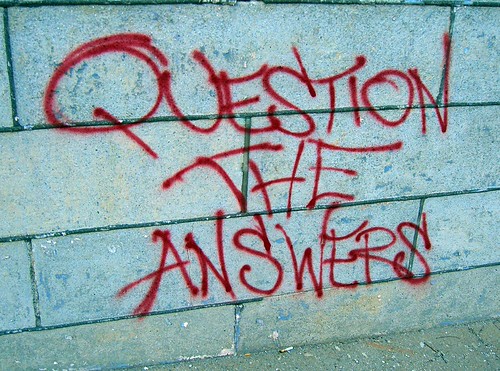
Question the Answers by walknboston, on Flickr
Photo credit: https://www.flickr.com/photos/walkn/3526522573/

In my last “Against Chronological Snobbery” essay I introduced the debate between the “progressive” view of American history (that America’s history has been one of clear moral progress) and the “non-progressive” view (that it hasn’t—i.e., that the question is at least subject to debate). I endorsed the latter position. Representing the “progressive view” was Justice Kennedy’s Obergefell opinion, together with Justice Marshall’s assertion that the founders lacked any remarkable degree of wisdom, and that the greatness of the Constitution is its more recent embrace of equality and individual rights. Representing the “non-progressive” view was Justice Robert’s dissent in Obergefell and Justice Scalia’s dissent in U.S. v. Virginia, both of which included a scathing rebuke of the majorities’ chronological snobbery.

In this essay, I hope to continue my attack on the “progressive” view by assaulting one of its citadels—the self-satisfaction of contemporary mainstream culture with regard to its own value system.

Continue reading

“Reductio ad Hitlerum”


I get it. The bad guys in these movies are like the Nazis (that means they must be really bad). Nothing is more frightening to the contemporary Western psyche than the rise of another Hitler. In our mind, Nazi Germany is the quintessence of evil. Although there was undoubtedly evil in the Nazi regime, I wonder if our obsession with Hitler and the Nazis has become unhealthy. Continue reading

Resolving gun violence with passionate polemics wont work

bridge-path-straight-wooden

I am sobered and frustrated by the news of recent shootings, and headlines cacophonic to the carols we sing at this time of year. And although I believe there are conversations to be had about gun control, I am also frustrated with the rhetoric from both sides of the debate because they so often employ alienation. Arguments laced with othering terms like “stupid liberals” and “clueless conservatives” may seem benign, but perpetuate the alienation that is epidemic in our politics and communities, which fertilizes seeds of hatred that eventually sprout in blossoms of bullets. Continue reading