
Funks Happen

looking-at-the-sea-1344478-1279x880

You have probably never heard of François-André Danican Philidor. If you were to see a picture of him, he would look like one of a hundred English aristocrats of the eighteenth century:  Large nose, powdery wig, silk cravat, waist coat, the works. He was a musician by trade but is remembered today because he wrote a book about Chess. In it he explored nine different ways to begin a game. What he realized, and is remembered for saying, is that “good play of the pawns [is] the soul of chess.”

And why are they the soul of chess? Because they are practically stationary. If chess represented war, the queen, knights, and rooks would be the armies and the pawns the terrain. So the way you orient your pawns at the beginning, dictates so much of how the rest of the game is played. And once they are established, they will remain for the rest of the game relatively immobile. The play happens around them.

The other week, I was angry at Sarah. Continue reading
How to have Courteous Conversations about Polarizing Issues

Video trailer for Courteous Conversations

At the beginning of the summer, David and I set out to find a way to help people who disagree over polarizing issues—even passionately, and often angrily—talk productively together. Fed up with the antagonistic political discourse so prevalent (and aggravated by the current presidential campaign), we wanted to create a situation where people would actually listen to the other side. (For a glimpse into why this kind of conversation is so important, check out this YouTube about political discrimination.) To do this, we had to remove incentives to argue, create a situation where participants felt safe, and take away platforms for rebuttal.

Here’s what we did: Continue reading

Against Chronological Snobbery: The Lightweight Modern Values of Equality, Tolerance, and Diversity

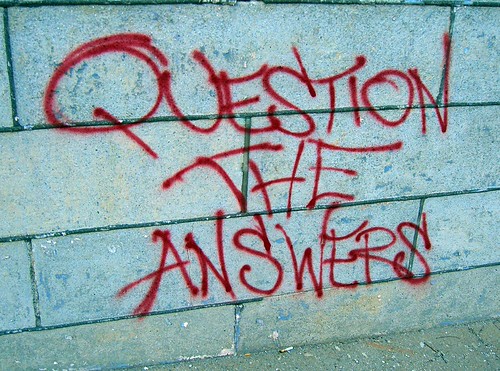
Question the Answers by walknboston, on Flickr
Photo credit: https://www.flickr.com/photos/walkn/3526522573/

In my last “Against Chronological Snobbery” essay I introduced the debate between the “progressive” view of American history (that America’s history has been one of clear moral progress) and the “non-progressive” view (that it hasn’t—i.e., that the question is at least subject to debate). I endorsed the latter position. Representing the “progressive view” was Justice Kennedy’s Obergefell opinion, together with Justice Marshall’s assertion that the founders lacked any remarkable degree of wisdom, and that the greatness of the Constitution is its more recent embrace of equality and individual rights. Representing the “non-progressive” view was Justice Robert’s dissent in Obergefell and Justice Scalia’s dissent in U.S. v. Virginia, both of which included a scathing rebuke of the majorities’ chronological snobbery.

In this essay, I hope to continue my attack on the “progressive” view by assaulting one of its citadels—the self-satisfaction of contemporary mainstream culture with regard to its own value system.

Continue reading

Why You Shouldn’t “Be True to Yourself”

love yourself photo
https://www.flickr.com/photos/quinndombrowski/with/5712669523/

We live in an age obsessed with self-actualization, self-fulfillment, self-realization, self-discovery, self-knowledge, self-esteem, self-expression, self-help, self-image, self-identity, etc. Selfies, iPhones, YouTube, me time. We’re self-obsessed.

The idea of “being true to yourself” implies that there is a core-self at our centers to which we could, theoretically, be false. But I doubt that. Continue reading

Questioning the Homo-/Hetero-/Bi-/Asexual Taxonomy – Part Four of Four: Final Thoughts

peace_in_time_of_monsters_by_delawer_omar-d6c3io9

I concluded Part Three by asserting that “society does and should take a hand in directing sexuality towards good results and away from bad ones”—but what counts as a “good” result, and how are good results to be encouraged? These are very important questions, but they are not the questions I am dealing with here. I will say only, in passing, that the authority to answer these questions is entrusted primarily to We the People (and not to the Supreme Court).

What I am dealing with here is not sexual morality, but sexuality simply as such: what is it? I have given no complete answer, but I have suggested that sexuality is NOT something that just happens to us. In particular, I have argued that (1) sexual orientation is not an immutable (i.e., unchangeable, inherent) characteristic of our natures, and (2) our culture should not impose on individuals a sexual identity based upon that orientation. Currently, our culture does impose such an identity by attempting to place everyone in one of four “immutable nature” boxes—homosexual, heterosexual, bisexual, or asexual. Continue reading

Questioning the Homo-/Hetero-/Bi-/Asexual Taxonomy – Part Three of Four: The Evidence of Your Personal Experience

431902450_4413ce64f9_o (2)

I claimed, at the end of Part One, that “the potentiality for sexual interest in either gender is natural in nearly all people in some degree.” In Part Two I explained my own experience, which bears this out. Here I mean to appeal to more general experiences that I’m sure I share with almost all readers to prove this point. Continue reading