Against Chronological Snobbery: The Lightweight Modern Values of Equality, Tolerance, and Diversity

Question the Answers by walknboston, on Flickr
Photo credit: https://www.flickr.com/photos/walkn/3526522573/

In my last “Against Chronological Snobbery” essay I introduced the debate between the “progressive” view of American history (that America’s history has been one of clear moral progress) and the “non-progressive” view (that it hasn’t—i.e., that the question is at least subject to debate). I endorsed the latter position. Representing the “progressive view” was Justice Kennedy’s Obergefell opinion, together with Justice Marshall’s assertion that the founders lacked any remarkable degree of wisdom, and that the greatness of the Constitution is its more recent embrace of equality and individual rights. Representing the “non-progressive” view was Justice Robert’s dissent in Obergefell and Justice Scalia’s dissent in U.S. v. Virginia, both of which included a scathing rebuke of the majorities’ chronological snobbery.

In this essay, I hope to continue my attack on the “progressive” view by assaulting one of its citadels—the self-satisfaction of contemporary mainstream culture with regard to its own value system.

Continue reading

Why You Shouldn’t “Be True to Yourself”

love yourself photo
https://www.flickr.com/photos/quinndombrowski/with/5712669523/

We live in an age obsessed with self-actualization, self-fulfillment, self-realization, self-discovery, self-knowledge, self-esteem, self-expression, self-help, self-image, self-identity, etc. Selfies, iPhones, YouTube, me time. We’re self-obsessed.

The idea of “being true to yourself” implies that there is a core-self at our centers to which we could, theoretically, be false. But I doubt that. Continue reading

Questioning the Homo-/Hetero-/Bi-/Asexual Taxonomy – Part Four of Four: Final Thoughts

peace_in_time_of_monsters_by_delawer_omar-d6c3io9

I concluded Part Three by asserting that “society does and should take a hand in directing sexuality towards good results and away from bad ones”—but what counts as a “good” result, and how are good results to be encouraged? These are very important questions, but they are not the questions I am dealing with here. I will say only, in passing, that the authority to answer these questions is entrusted primarily to We the People (and not to the Supreme Court).

What I am dealing with here is not sexual morality, but sexuality simply as such: what is it? I have given no complete answer, but I have suggested that sexuality is NOT something that just happens to us. In particular, I have argued that (1) sexual orientation is not an immutable (i.e., unchangeable, inherent) characteristic of our natures, and (2) our culture should not impose on individuals a sexual identity based upon that orientation. Currently, our culture does impose such an identity by attempting to place everyone in one of four “immutable nature” boxes—homosexual, heterosexual, bisexual, or asexual. Continue reading

Questioning the Homo-/Hetero-/Bi-/Asexual Taxonomy – Part Three of Four: The Evidence of Your Personal Experience

431902450_4413ce64f9_o (2)

I claimed, at the end of Part One, that “the potentiality for sexual interest in either gender is natural in nearly all people in some degree.” In Part Two I explained my own experience, which bears this out. Here I mean to appeal to more general experiences that I’m sure I share with almost all readers to prove this point. Continue reading

Questioning the Homo-/Hetero-/Bi-/Asexual Taxonomy – Part One of Four: The Evidence of History


kinsey-scale

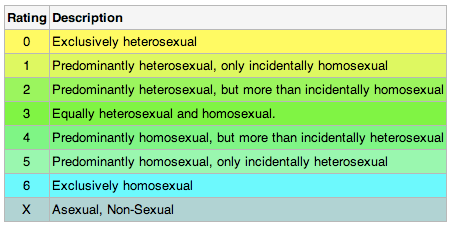
There is reason to doubt the veracity of our current taxonomy of sexualities: a person (we think) is by nature homosexual, heterosexual, bisexual, or asexual. Admittedly, this system has an intuitive appeal: there are two genders (basically); one may be attracted to one, the other, both, or neither. There are no other possibilities. This satisfying quality of logical completeness is misleading, however.

The first and most important piece of evidence against our system is that people never thought of sexuality in this way prior to the 19th century. Continue reading

Ballroom Dance Could Save Your Relationship


[Note: This post was coauthored by our sister Rachel Sabey, a professional ballroom dancer and dance instructor in New York City, shown dancing with her partner in the YouTube video. It is written in her voice. David’s dance qualifications are similarly impressive, as he is the proud recipient of an A and a bronze certification in the beginning ballroom dance class he took at BYU. Despite this auspicious early dance career, he set aside the glory and glamor of the ballroom to devote his time to the public service.]

When an engaged couple comes to me for lessons, they come onto the floor smiling at each other, holding hands. And just before we start, he leans over and kisses her on the forehead. It’s an adorable picture, one for a newspaper, until they start to dance. That’s when the fighting begins. Sooner or later (and usually sooner) nearly all engaged couples will fight while learning their first dance. Romantic images of waltzing across clouds with your new spouse quickly fade when you realize dancing isn’t as easy as it looks. As a dance instructor, I feel funny asking these adult students to stop fighting and listen to what I am saying. At times, I want to remind them that they are planning to spend the rest of their lives with this person and it’s not a good sign if they can’t even make it through a dance lesson. Of course that might be an untimely thing to say to an engaged couple, but the impulse can be hard to resist. Continue reading