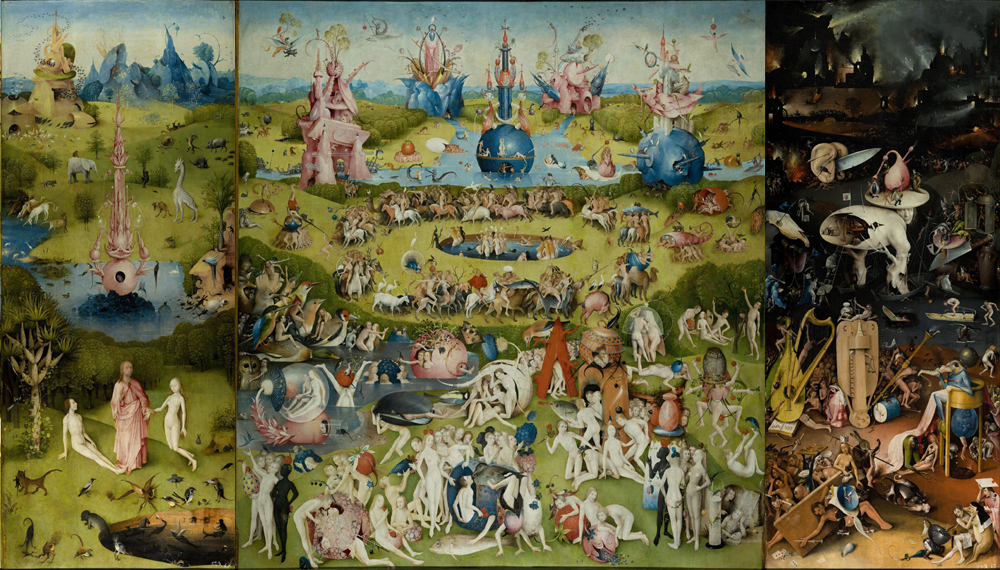
It is commonly believed that the truth is always in the middle. Given any two views or any two disputants or any two accounts of an event, both sides have some of it right and some of it wrong; therefore, both sides need to move towards the center.
While this may be a good rule of thumb when it comes to human disputes—divorces, litigation, discrepancies between two people’s memories, etc., it is nonsense as a rule. It often happens that one side is simply right and the other simply wrong.
More importantly, it is utter nonsense in the realms of thought and creativity. When it comes to world views, thought systems, and artistic schools, to make compromise a rule would merely be to abandon consistency and rigor. Continue reading →
As I begin to write about the worst Fascists (i.e., the Nazis), it occurs to me that humanity is altogether more wonderful and more terrible than we commonly imagine it, more angelic and more diabolical. The mundanity and the moral and intellectual mediocrity of most lives is not the native and inevitable condition of the average human soul, but rather an impasse between vast forces of good and evil and immense impulses towards life and towards death. From this conflict we seek refuge in numbing routine and stultifying dogma, content for the most part to experience the battle at a safe remove, transmuted into art. Our impulse towards life and effort, fierce as the Sun, is satiated, because we are thinking and acting; and our impulse towards rest and stillness, inexorable as outer space, is mollified because our thoughts and actions rotate, like the Earth itself, in the same circuit every day. Continue reading →
I recently read Jonathan Haidt’s book The Righteous Mind: Why Good People Are Divided By Politics and Religion. It is worth reading, but it was a very mixed emotional experience for me. Politically, it was interesting, insightful, and personally affirming, while philosophically it was interesting, insightful, and personally aggravating. Continue reading →
How’s this for a lighthearted proof of the devil’s existence: there is no reason that a person cannot at one and the same time have a robust moral code and charity towards those who fail to satisfy its rigors. That is in fact what Christianity has always demanded. Likewise, there is no reason one cannot have both a commitment to systematic foundational doctrines and openness to other perspectives and even to revising one’s own most basic beliefs in response to new evidence or insights. Yet for some mysterious reason, despite numerous individuals and even small sub-cultures demonstrating that these ideals can be achieved, they have never been realized by any society in recent recorded history, nor have any of the ancient societies that have claimed to have achieved some utopic vision at some point in their history been able to maintain the achievement.
Western society before the Enlightenment had a comparatively exacting moral code and a strong commitment to certain doctrines, including but not limited to those of Christianity, yet it was decidedly unchristian in its responses to moral infractions and religious dissent. There is no reason it could not have progressed towards tolerance and openness while keeping its faith. That is exactly what Christianity’s law of love required, and I think it was desire for power far more than for truth or for God that caused intolerance and dogmatism to be so dominant for so long. Martin Luther King Junior’s message, though not all aspects of his life, perfectly demonstrated the possibility of remaining fully Christian while moving away from dogmatism and intolerance, and he is only one prominent figure within a multitude of whom the same could be said. Their stories are the leaven within the story of civilization. “I have seen the promised land,” he claimed–and for my part, I believe him.
But we have not followed Martin Luther King’s message of brotherhood. Continue reading →
“The World” here is defined in contradistinction to “the Church.” The fundamental difference for present purposes is that the Church recognizes the authority of God’s commandments respecting sex while the World follows its desires regardless of God’s commandments. People do not divide neatly in the World and the Church, but at the same time the distinction is more than theoretical. I am sure that there are atheists who eschew sexual whateverism and, for their own reasons, promote faithfulness within loving dual gendered marriage as the only ethical expression of sexuality; but I cannot think of a single person I actually know who fits this category today. The vast majority of those who remain unmoved by the sexual and ideological revolutions of the last century are the religious–and most major religions (including at least Hinduism, Christianity, Islam, Sikhism, and Judaism) have historically spoken with virtual unanimity on the subject. Buddhism, of course, considers liberation from all desire and attachment the ultimate goal, and it therefore has perhaps an even less permissive stance towards sexuality than the other major religions.
While the nearly unanimous consensus of the world’s major religions is so strong an argument in favor of traditional sexual morality as to be, in my judgment, very nearly conclusive, I do not insist on traditional sexual morality for present purposes. What I insist on is that people must attempt to comply with a moral and philosophical system that is dictated by reason and conscience and not by desire. Desire must bow to Right (“as God gives us to see the right”), not Right to Desire. To the extent that a rigorous and conscientious atheist regulates his sexuality by the morality that seems to him correct and yet denies the authority of God’s purported commandments, he is outside the Church but also outside the World. Continue reading →
Our actual experience of sexuality is full of ambiguities. There are at least three major sources of ambiguity that I can discern:
The gap between reproduction itself and the bodily and mental processes associated with reproduction.
The slippage inherent in language.
Differing world views and philosophies of sexuality.
There can be no serious claim that sexuality lacks ambiguity, because intelligent people and cultures interpret it so differently. I am not an anthropologist, but I know just enough to know that anthropology furnishes precious few universals across cultures within the realm of sexuality. The few that do exist, according to Wikipedia’s page on cultural universals, include a prohibition on incest, some form of cultural dress code (sexual modesty is described as a “cultural universal” here), and some form of marriage. Continue reading →