In Defense of Dogmatism

Amazon’s “look inside” feature has preserved intact a perfect little essay from the book, “Things That Are,” by Amy Leach. I have met Amy Leach–I even hiked in Provo’s beautiful Rock Canyon with her, her husband, and my personal essay class, courtesy of Patrick McMadden, my essay teacher, who I think was involved in getting her to come out to BYU and read from her book during BYU’s Friday Reading Series. If you will follow the above link, use the “look inside” feature, and search the word “hoopoe,” you will find a complete, lovely, and very short essay titled “God.”

In this essay, Amy Leach points out that men take the name of God in their mouths, but they do not speak God’s words. “They say it pleases him, to say his name incessantly. They sing it in songs and chant it together and broadcast it loudly on the radio, on signs. Perhaps it pleases him. I do not know. It does not please me.”

These iterations of his name are totally different from his words. God’s words, according to this essay, are his creatures, who “mount up with wings or leap through brambles or swim blackly in ponds.”

I find this essay utterly charming, like the rest of the book, but I also find something lacking in the treatment of how men speak God’s name. Continue reading

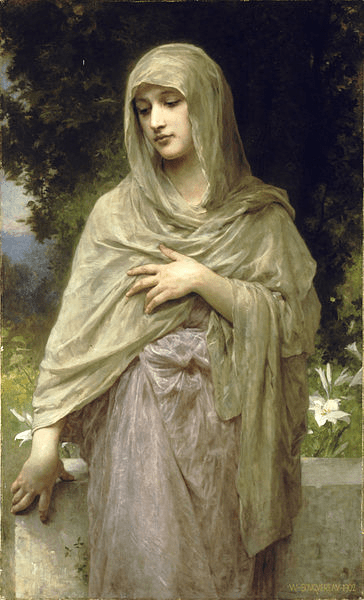
In Defense of Modesty

Modesty, Oil by William Adolphe Bouguereau

Modesty, like reverence, is becoming a forgotten virtue. Calls for modesty in dress in ultra-orthodox jewish neighborhoods are perceived by some as a violation of human rights. Others, less extreme, view codes of modest dress as stifling individual expression or as shifting responsibility for men’s sexuality from the men themselves to women. Now, it may or may not be a good idea to post signs in the hasidic neighborhoods. And codes of modest dress may indeed be misinterpreted by men as absolving them of responsibility for their own sexual behavior. But regardless, modesty is still a virtue–and one that deserves to be encouraged and inculcated.

We use the term “modesty” in the context of dress and in the context of personal achievement, but the core of the idea is the same Continue reading

The Delusions and the Truth of Romance

Image result for soulmate
photo credit: http://www.powerofpositivity.com/soulmate-relationship-signs/

Too many people seek lasting happiness and fulfillment in romantic love, where it is not to be found.

What romantic love offers is agitation, desire, a fevered preoccupation with the object of love, the blithe contemplation of an other. There is beauty and there is truth to be found in romantic love, but no lasting happiness or fulfillment. That “happily ever after” is to be found in romantic love is the first of its delusions.

Yet there is something undeniably beautiful about two souls waltzing in a private heaven, loving and being loved. But one falls when one waltzes in heaven. Romance either lands on the earth of daily life or it combusts in tragedy. By the “earth of daily life” I mean mainly marriage or the modern forms of pseudo-marriage. The only realistic alternative to these is some form of tragedy–breaking up or dying or in some other way being separated. These melancholy obstacles to consummation are the only way to prevent romance from descending into the soil. And that is why romantic novels and movies inevitably end shortly after consummation (traditionally, marriage). The last scene may be the wedding; or the story may play out just long enough to witness the tragic pre- or post-consummation death of one or both lovers (as, e.g., Tristan and Isolde or Romeo and Juliet). Continue reading

The Stupidity of Belief Against Evidence And The Essence of Faithfulness

Thence we came forth to rebehold the stars.  {my favourite Dante quote.}:

Photo credit: https://www.pinterest.com/pin/129478558011794613/, “Thence we came forth to rebehold the stars.”

There is a facile enthusiasm about “believing” that is manifest every Christmas season and often enough in-between. Sentimental movies like “The Polar Express” and “The Miracle on 34th Street” chime in with their paeans to believing, and even works like “The Life of Pi” suggest that it is proper and even admirable to accept as true “the better story” even when it is the unlikeliest story imaginable.

At the front end, let me admit that there is a kernel of truth in these expressions. But there is also great danger is assuming that optimism can or should trump reason, and that belief in the truth of whatever appears good or lovely is itself necessarily good.

At least in questions where the relevant evidence is capable of being comprehensively considered, the proper formula is very simple: belief should be according to the evidence. Continue reading

History and Import of Religious Liberty: Summary and Conclusion (This One Is Kinda Short, Guys) Part Three of Three

2613627233_6b7d42be1d_b

In parts one and two (to summarize), I argued that until the last few hundred years, it was not practically possible, nor was it considered desirable, for any state or any people to refuse to establish a religion. Individual religious liberty has occasionally been tolerated, but it has always existed alongside an official religion. For the vast majority (roughly 99.85%) of human history, during most of which we lived as tribes, each people has considered it necessary to enjoy the “thick” belonging that comes from common beliefs, common rituals, and a common sense of the sacred, divine, or ultimate. Continue reading

History and Import of Religious Liberty: A Tale of Two Opinions and the Further Thinning of Society, Part Two of Three

Image result for pledge of allegiance

The ultimate foundation of a free society is the binding tie of cohesive sentiment. Such a sentiment is fostered by all those agencies of the mind and spirit which may serve to gather up the traditions of a people, transmit them from generation to generation, and thereby create that continuity of a treasured common life which constitutes a civilization. ‘We live by symbols.’ -Justice Frankfurter in Gobitis.

I began this series with a brief history of religious freedom, emphasizing the shift from “thick” to “thin” societies from prehistorical days through the founding of America. I concluded by asserting that the establishment clause was a radical new experiment: never before had a nation forsworn any religious ties. Nor was it certain whether a nation could survive in the long term without the kind of civic belonging and shared beliefs that a common religion fosters perhaps better than anything else. The experiment, while neither so radical nor so new as it was in 1789, is ongoing, and its success is not yet assured: for as we have less and less in common regarding our most fundamental beliefs and commitments, we seem to experience a shallower and shallower sense of civic belonging.

Conditions of the Experiment’s Success

Under what conditions is liberalism’s experiment most likely to succeed? How can plurality as to comprehensive doctrine be reconciled with a sufficient degree of unity to preserve the nation? First and foremost, as John Rawls suggests, a certain degree of “overlapping consensus” is necessary.[1] We may not agree on all things but we must agree on some things. A society united by nothing other than the accident of existing together under the same government—not by a general approbation of the form of government and its laws; not by common values and traditions; not by a commitment to seeking and pursuing a common vision of the good—is a society that is doomed to disintegrate, for it is incapable of inspiring loyalty and sacrifice, or even maintaining law and order. Continue reading