Questioning the Homo-/Hetero-/Bi-/Asexual Taxonomy – Part Two of Four: The Evidence of My Personal Experience

sexualorientation-hypnotherapistcork

I think I became aware of the fact that sexual orientation is supposed to be an important part of one’s identity around 4th or 5th grade. I made a special homemade valentine’s card for another boy who had moved in. I was not romantically interested in him; I meant it as a special gesture of welcome. But he avoided me thereafter. In middle school, my male peers would talk knowingly of which female classmates were “hot,” but would profess utter ignorance about which male classmates were attractive. Female peers did the same. Being male (and straight, though this part went unspoken) meant, so we thought or affected to think, that the attractiveness of the other gender was transparent and that of our own opaque. Which, of course, is utter nonsense.

For as long as I have been attuned to the beauty of the human form, I have been attracted by male beauty as well as by female beauty—though my appreciation of male beauty more easily remains purely aesthetic, while my appreciation of female beauty more easily becomes erotic. Continue reading

Questioning the Homo-/Hetero-/Bi-/Asexual Taxonomy – Part One of Four: The Evidence of History


kinsey-scale

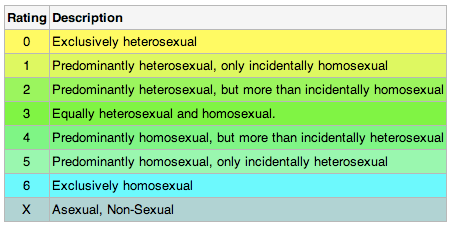
There is reason to doubt the veracity of our current taxonomy of sexualities: a person (we think) is by nature homosexual, heterosexual, bisexual, or asexual. Admittedly, this system has an intuitive appeal: there are two genders (basically); one may be attracted to one, the other, both, or neither. There are no other possibilities. This satisfying quality of logical completeness is misleading, however.

The first and most important piece of evidence against our system is that people never thought of sexuality in this way prior to the 19th century. Continue reading

An Invitation to Join The Book Club of the Ages.

iStock_000005885818Small
Photo courtesy of ©iStockphoto.com/naphtalina

Think back with me: what’s the last book you read? Not your textbooks or your washing machine owner’s manual, but your free-time reading. Was it from Oprah’s Book List or maybe the New York Times Bestsellers? The newest spine-freezer or rib-tickler or even (yikes) bodice-ripper?

In the spirit of the coming New Year and self-improvement, let me try to convince you to change up your reading habits. Let’s consider C. S. Lewis’s advice:

It is a good rule, after reading a new book, never to allow yourself another new one till you have read an old one in between. If that is too much for you, you should at least read one old one to every three new ones.[1]

Ugh, those stuffy relics they tried to get me to read in Humanities 101?

Yes, precisely. Reading old books will save us from ourselves. Continue reading

Umbilical Cords, Belly Buttons, and Breastmilk: The Drama of the Generations

cathedral
The Milan Cathedral (the Duomo), constructed 1386 thru 1577, depending on how you count. Photo credit: http://adventurejay.com/blog/

“He will turn the hearts of the parents to their children, and the hearts of the children to their parents . . . .” Malachi 4:6

We are parents to a 15 month old girl named Zina, with another’s anticipated arrival in less than two months. Before Zina joined us, we had a miscarriage. (Perhaps Dia will someday post some of her thoughts about that difficult experience.) Over the three years of our marriage, we have had our hearts turned to our children—and to our parents. We have more fully joined the drama of the generations: more than before, we recognize that we are participants in a circling narrative of birth, parenting, marriage, and death that stretches vastly beyond our lives’ short timelines in either direction.

I wish I knew more about my ancestors. Their hopes, their dreams, their hobbies, their passions and preferences and personalities. I’m sure that I figured in some of those hopes and dreams, in some shadowy way. Dia recently wrote about how people in earlier ages, to a much greater extent than we, pinned their hopes and the very meanings of their lives on the prospect of posterity to continue their legacy, to carry on their memory and their way of life, to continue to build the cathedrals when their hammers and their bodies were spent. Continue reading

Let’s Talk About Sex: A Note to My Future Son


venus-de-milo-psd18297

Dear son,

You have known about the birds and the bees for many years; the basics of human sexuality and reproduction are no mystery to you—though no doubt you have a healthy dose of natural curiosity about what sex is like to experience. (Don’t panic! This note will not attempt to answer that question!) Without saying much about what sex is like, I want to say something about what sex is not like, in order to explain why pornography offers something totally different from sex. Continue reading

Thomas More, Martyr of Traditional Marriage: Part Two—His Time, and Ours

Thomas-More-and-Family

In late polyphonic music the central aspect is the delicate interplay of voices without any single one of them taking precedence. In music of a century later we find the dramatic use of a powerful individual voice, but in fifteenth-century English polyphone the emphasis rests upon the intricate melody of many voices. The character and abilities of the individual are only of consequence as an element within the harmonious organization of parts; we do not know the names of the masons who created the bell towers and fan-vaults of the great fifteenth-century churches. This is not the world of Luther or of what has become known as post-Reformation culture, but it remained the world of Thomas More.

From Thomas More, by Peter Ackroyd

In this essay, I hope to trace some parallelisms between the moral shifts in Thomas More’s day and those in ours. The comparisons are, of course, imperfect. But I think they are also significant. Continue reading