
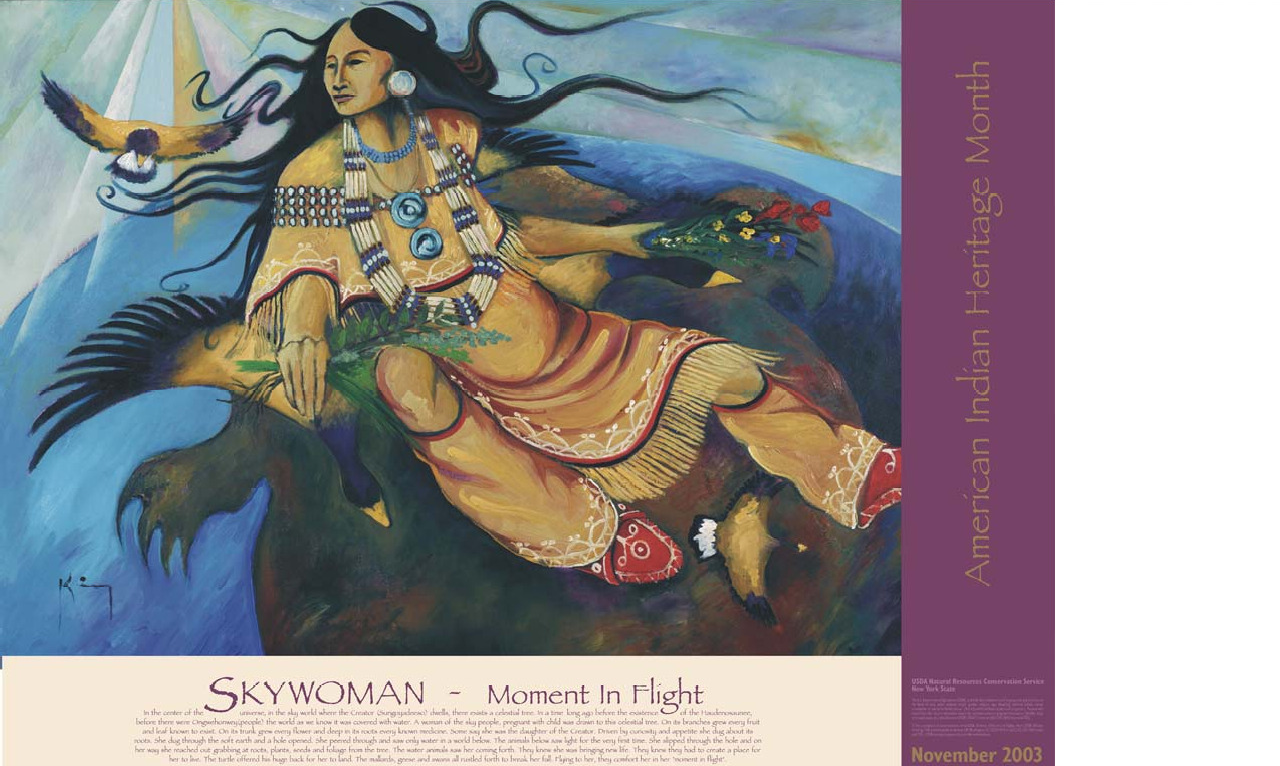
In my last post, I argued that the evidence of science profoundly supports intelligent design. The following is offered not as an additional argument or an evidentiary supplement but as a methodological supplement or perhaps even a corrective. There are, as Robin Wall Kimmerer argues, other ways of knowing than the scientific. The sheer wonder, grace, and givenness of creation, and our proper relationship to it, are perhaps captured better–and certainly more concisely–in creation myths than they are in scientific writing. Plus, I thought it was beautiful and wanted to share it. Consider this a step in my own “dance” of thanksgiving for the earth.
Thanks and credit to https://www.tweetspeakpoetry.com/2018/12/20/skywoman-falling-reprint-from-braiding-sweetgrass-by-robin-wall-kimmerer/ and Robin Wall Kimmerer, who opens her lovely book Braiding Sweetgrass with this myth. The rest of this post is a direct quote from that book:
In the beginning there was the Skyworld.
She fell like a maple seed, pirouetting on an autumn breeze.* A column of light streamed from a hole in the Skyworld, marking her path where only darkness had been before. It took her a long time to fall. In fear, or maybe hope, she clutched a bundle tightly in her hand.
* Adapted from oral tradition and Shenandoah and George, 1988.
Hurtling downward, she saw only dark water below. But in that emptiness there were many eyes gazing up at the sudden shaft of light. They saw there a small object, a mere dust mote in the beam. As it grew closer, they could see that it was a woman, arms outstretched, long black hair billowing behind as she spiraled toward them.
The geese nodded at one another and rose together from the water in a wave of goose music. She felt the beat of their wings as they flew beneath to break her fall. Far from the only home she’d ever known, she caught her breath at the warm embrace of soft feathers as they gently carried her downward. And so it began. Continue reading
 The Brothers Sabey