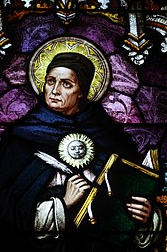
Against Systematic Theology

Tell all the truth but tell it slant —

Success in Circuit lies

Too bright for our infirm Delight

The Truth’s superb surprise

As Lightning to the Children eased

With explanation kind

The Truth must dazzle gradually

Or every man be blind —

-Emily Dickinson

I participate in a theology book club in which we are reading Exploring Mormon Thought, by Blake Osler. Osler is interesting in that he is doing systematic theology, but at the same time he questions the value of systematic theology, doubts its ability to attain its own goals, and admits the limitations of language and the necessity of experiential and relational knowledge in spiritual matters, in contrast to propositional beliefs.

I agree with his questions, doubts, and admissions. I appreciate his work and consider it worthy of our time and attention, but I could be just as good a Christian without once cracking a book of systematic theology.

Now I want to be clear that I am fully in favor of careful thought and intellectual rigor, of seeking greater and greater light and knowledge. Indeed, doing so is a spiritual necessity. If our light and knowledge is not growing, it is shrinking (see Alma 12). Far more than most brands of traditional Christianity, LDS thought enjoins intellectual effort as a duty: we are commanded to “seek out of the best books words of wisdom” and informed that we cannot be saved in ignorance. My target here is not intellectual effort or even theological carefulness, but solely systematic theology. Continue reading

Being Placenta

So far, we’ve had two babies. Both boys. I’ve seen them come into the world, wet, followed by placenta. The nurse unfolded the slimy mound and showed it to me. “Look,” she said, “the tree of life.” It actually looks like a tree, the blue blood vessels forking like branches from a trunk. The way the nurse spoke, with rapture, it was clear she was not feigning her amazement. This was an authentic placenta fan. She had me run my finger across the oozy membrane. Like a fish, or ray, or some other deep ocean organism. My wife was less interested. 

And that was not surprising. Her body was full of recovery. The pain, still seeping out of her muscles, and relief swelling in like the tide. Of course, the placenta was nothing in this moment. Some seaweed caught in a wave. This was a moment when a new baby’s cry was filling the room as it tried to latch onto his mother’s breast. And so I took a picture, to show Sarah after. After she had some time to recover. After the baby was less marvelously new. When the miracle of a placenta might be observed for its own beauty, un-eclipsed and un-eclipsing. 

But Sarah never cared much about the placenta. It was, to her, just a little bit gross. Like observing her own fecal matter. Something her body produced that was necessary, but best unobserved. So Sarah is not a placenta fan. She is not like Dia, my brother’s wife, who eats her own placenta after birth. This might seem like crazy-granola-lady-hippie behavior. But it is common in almost all mammals and just about every animal that produces a placenta. There are only a few exceptions including aquatic animals, camels, and most humans. 

Continue reading

Miracle

mary magdalen at the tomb of our saviour

In the Gospel of Matthew the often repeated words, “he is risen” are preceded by the statement, “he is not here.” Then as evidence of the risen Lord, the angel invites Mary to see the absence of the Lord’s body from the tomb. But the missing body only highlights the questions already burning in her heart. The very questions which caused her arrival in the garden tomb in the first place: where did he go and where is he now?

As is often the case with Christ’s miracles, the supernatural aspect underscore the common reality: people die. And while the body is usually left behind, we are left to wonder how it could be so entirely abandoned. How an object which had once been a man has ceased to present a human being. How the formaldehyde fails to preserve key aspects, even physical aspects, of the person we knew. And it is by this common, natural reality—the incongruity of death—that Christ’s missing body moves us, and not the other way around. The loss of a friend, a father, a lover, a son. Touching a corpse, holding an embalmed hand, kissing a dead man’s lips, nothing more profound than these are required for us to have asked the question: Where did she go? Where is he now? Continue reading