Jane the Virgin and A Case for Guilt

635992720114068681-2108137969_18278


The third season of Jane the Virgin starts on Monday. I just complete the first two seasons (though I may have skipped a few, okay maybe like ten, episodes). And I have to admit, I enjoyed myself, though I have some serious reservations.

According to critical consensus at Rotten Tomatoes, the show manages to be charming despite its  “dubious premise.” Here’s the premise: a girl has agreed to practice abstinence until marriage but then a whole bunch of drama happens after she is accidentally artificially inseminated. So what’s so dubious about this premise? It risks becoming sanctimonious. People don’t want to watch a show that even hints at religious dogmatism. Continue reading
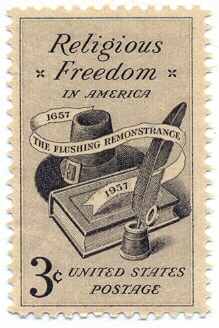

History and Import of Religious Liberty: The Shift to “Thin” Societies, Part One of Three

This is the first in a series of essays in which I hope to examine the history of American religious liberty—in particular, the backstory, interpretations, and shifting moral valence  of the Establishment and Free Exercise Clauses of the Constitution.

“The past is never dead. It’s not even past.”[1] The immediate historical backstory against which the Establishment Clause is set is the institution of the European state churches that impelled many colonists to leave Europe in pursuit of religious freedom. Most historical accounts of the Establishment Clause begin and end here. But the background of European state churches is the Peace of Westphalia, the religio-political wars that preceded it, and the Reformation.[2]  Some historical accounts reach this far back. But to thoroughly understand the significance of the Establishment Clause I think we need to reach further—all the way back to pre-history. Continue reading

The Accidental Christianity of Hollywood

star-trek-beyond-zoe-saldana-john-cho.jpg

I’m watching Star Trek Beyond and Krall just threatened to kill Sulu in order to coerce the crew into giving him the Abronath (a bioweapon capable of huge destruction). But rather than letting a crew member die, an Ensign named Syl turns over the weapon from its hiding place in the back of her head. It’s a very familiar scene. You find similar scenes in Star Wars, most of the superhero films, and even children movies like Disney’s Hercules. Remember when Hercules gives up his power to save Meg and thus allows Hades to terrorize the city and even assault Mount Olympus?

My complaint is not that this trope has become repetitive (here’s a long list of similar scenes), but that we simply accept it as a legitimate ethical decision. Do we agree that it is appropriate to surrender thousands, millions, possibly billions of lives (the stakes keep getting higher) in order to save Sulu? Why does this ever make sense? Spaceballs even parodies this trope when The King sacrifices himself and the entire population of his home planet just so the princess doesn’t get her old nose back. When it’s a nose, we understand the absurdity, but that absurdity is harder to recognize when someone’s life is at stake. Continue reading

Simplistic Political Morality Won’t Heal Our Country; It Will Make Things Worse

1000px-biohazard-svg


I thought about beginning this post with a not-so-subtle comparison of the current political situation and discourse with the most gossipy and mean-spirited parts of the elementary school playground. Although something about this metaphor appeals to me, I decided against it because I risked doing that which I intend to critique: Dogmatically retaliating against the expression of opinions that oppose mine. So, instead of beginning with satire, let me begin with a confession: I used to think of pubs and bars as immoral places. Continue reading

Single Narratives About Terrorist Attacks And Police Shootings

stop-islamophobia

This last week two things coincided: I attended a panel discussion on islamophobia and my facebook friends reacted to the news of Keith Scott being shot by a police officer. These might seem unrelated, but the more I thought about it, the more I realized that these experiences were really about the exact same thing: the human capacity to form narratives and hold on to them. Let’s start with the panel.

Three professors took turns speaking. Their point was that the narrative people have developed about Arabs and Islam is not accurate. People fear Arabs because they’re Muslim. But this is often not the case. There are a lot of Christians, Sikhs, and even agnostic Arabs. And people fear Muslims because of all the terrorist attacks. However, you are much more likely to be killed by lightning than by an Islamic extremist. According to one of the lecturers, Islamic extremism has only killed 109 Americans since September 11th 2001. That might sound like a lot, and every life is precious, but if you run the numbers, there is an infinitesimally small chance that you’ll be one of them. More people die falling out of bed. A lot more: it kills 737 Americans annually. Continue reading

Advice from asaasa1983 that we should all ignore

unnamed.jpg
We recently received a message from “asaasa1983” in response to an article we had written. The article was about helping children nourish healthy sexuality while avoiding destructive and deceptive outlets like pornography. To me it is a relatively secure platform.

Both statistically and within my own anecdotal experience, pornography can have a negative influence on relationships. It’s bad for the viewer and often bad for the people on the other side of the screen—the ones taking the pictures. However, I am not entirely ignorant of arguments against conservative sexual mores. We can come across as uptight, prudish, genophobs. And before I go forward I want to acknowledge that conservative sexual paradigms have at times been restrictive, narrow, and damaging. So there’s certainly some constructive liberal critiques worth listening to.  

Still I was surprised by asaasa1983’s response—so surprised in fact that I reproduce it here in its entirety: Continue reading