You’re Conservative. What Do You Think about Trump’s Win?

donald_trump_by_gage_skidmore_5

In short, I’m tired. For over a year, I have paid close attention to this political race. Last night, I stayed up, glued to the screen as my expectations were upturned. At the beginning of the race, I watched the debates with enthusiasm, but I eventually refused to watch them; I thought they were a mindless spectacle, ill-befitting the office of the president. I could not understand why people favored Trump in the Republican Primaries, and I was surprised when he won the nomination. I didn’t think he stood a chance in the general election, and I watched in shock as state after state voted for him. As it became ever more likely that Trump would win the election, my Facebook feed filled with messages of dismay, sadness, and fear. Some of my Latinx students, now sophomores in high school, posted things like, “I’m going to be deported” and “This is the end.” They are young and melodramatic, but I think their fears are real. Other dear friends wrote about their crushed hopes, their sense of rejection, and their growing concerns. No shattered glass ceiling. No continuation of Obama’s legacy. No validation for progressive values. And not just these unmet expectations, but a sense of danger for women, immigrants, Muslims, and other marginalized populations. There is real pain, fear, and sadness among Hillary Clinton supporters today. I feel for and with them. Continue reading

Political Opinions are like Haircuts

562f7f871400002b003c9375

When the body perceives a sudden threat, not only is adrenalin released in our blood, but even on the surface of our skin there is a measurable reaction that takes place within 0.05 seconds. And if you can track that, you can get a pretty good idea about how scared someone is. And we can track that. As it turns out, conservatives are more scared than liberals.

Studies like this have becoming increasingly popular as political polarization increases in the US and across the world. In the US, people want to know what makes a Republican different than a Democrat. We’ve learned so much about it that, according to Jonathan Haidt, after a few tests we can not only estimate with reasonable accuracy where someone will come down on political issues, but also what places they want to travel, books they’d like to read, and restaurants they’d enjoy. So the real wonder is not what separates the two parties, but what makes people within those parties so similar—even across seemingly unrelated issues. Continue reading

History and Import of Religious Liberty: Summary and Conclusion (This One Is Kinda Short, Guys) Part Three of Three

2613627233_6b7d42be1d_b

In parts one and two (to summarize), I argued that until the last few hundred years, it was not practically possible, nor was it considered desirable, for any state or any people to refuse to establish a religion. Individual religious liberty has occasionally been tolerated, but it has always existed alongside an official religion. For the vast majority (roughly 99.85%) of human history, during most of which we lived as tribes, each people has considered it necessary to enjoy the “thick” belonging that comes from common beliefs, common rituals, and a common sense of the sacred, divine, or ultimate. Continue reading

People Hate and Love Trump for the Same Reason

p23-iconoclasm-800x500

Next year, on Halloween, we will be celebrating the 500th anniversary of the reformation. And there’s a chance we will be celebrating it with a new leader equally iconoclastic: Donald Trump.

St. Martin’s Cathedral is tall and gothic. The whole structure is made from dark red brick, massive windows, and pointed spires. Once it was the largest cathedral in the Netherlands. But much of it has collapsed. Today, only the most impressive structures remain including the large stone edifice known as the Dom Tower. Inside the building, above the altar, there’s this ornate relief sculpture of eight figures, the details still fresh as when it was first made. The figures converse around a throne and seem to be reading out of a large book. Above, as if looking down from heaven, another figure oversees the scene. It seems to be a depiction of God’s promise in Matthew: where two or more are gathered in my name, there I will be also. Continue reading

Honestly, Why Do Conservatives Hate Hillary Clinton?

51056208f08c7cd595c97ecbf1fd83611472053034581

Most conservatives hate Hillary Clinton. And a lot of liberal articles have come forward recently asking people why. To them, the only reasons could be because you’re misinformed, ignorant, or a misogynist. Of course I don’t think this is the case, but I too have wondered why people hate Hillary. I am generally conservative, but I actually haven’t formed much of an opinion on her. My only real objection to her was the same objection I had with George and Jeb Bush. I don’t like aristocracy. I don’t like the idea of two people in the same family becoming president. It just means there’s a lot of who-knows-who going on.

But besides that, my thoughts on Hillary have actually been fairly innocuous. Much of this is because of a simple childhood memory. My uncle was a big-wig Economist in Houston and being young and impressionable I trusted whatever he said. As a group of us talked, he described how impressed he had been with Hillary’s work ethic. I was too young to know what they were talking about, but I left that conversation with one idea: Hillary Clinton was a hard worker. That went a long way for me.

From then until now something has changed. For whatever reason, whenever Hillary is mentioned there’s this sour taste in my mouth—nothing of substance, just a feeling about her. A feeling that isn’t even my own. And so I performed an honest evaluation: Why do conservatives, and why did I, dislike her.   Continue reading

History and Import of Religious Liberty: A Tale of Two Opinions and the Further Thinning of Society, Part Two of Three

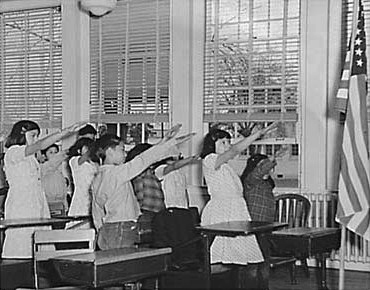
Image result for pledge of allegiance

The ultimate foundation of a free society is the binding tie of cohesive sentiment. Such a sentiment is fostered by all those agencies of the mind and spirit which may serve to gather up the traditions of a people, transmit them from generation to generation, and thereby create that continuity of a treasured common life which constitutes a civilization. ‘We live by symbols.’ -Justice Frankfurter in Gobitis.

I began this series with a brief history of religious freedom, emphasizing the shift from “thick” to “thin” societies from prehistorical days through the founding of America. I concluded by asserting that the establishment clause was a radical new experiment: never before had a nation forsworn any religious ties. Nor was it certain whether a nation could survive in the long term without the kind of civic belonging and shared beliefs that a common religion fosters perhaps better than anything else. The experiment, while neither so radical nor so new as it was in 1789, is ongoing, and its success is not yet assured: for as we have less and less in common regarding our most fundamental beliefs and commitments, we seem to experience a shallower and shallower sense of civic belonging.

Conditions of the Experiment’s Success

Under what conditions is liberalism’s experiment most likely to succeed? How can plurality as to comprehensive doctrine be reconciled with a sufficient degree of unity to preserve the nation? First and foremost, as John Rawls suggests, a certain degree of “overlapping consensus” is necessary.[1] We may not agree on all things but we must agree on some things. A society united by nothing other than the accident of existing together under the same government—not by a general approbation of the form of government and its laws; not by common values and traditions; not by a commitment to seeking and pursuing a common vision of the good—is a society that is doomed to disintegrate, for it is incapable of inspiring loyalty and sacrifice, or even maintaining law and order. Continue reading