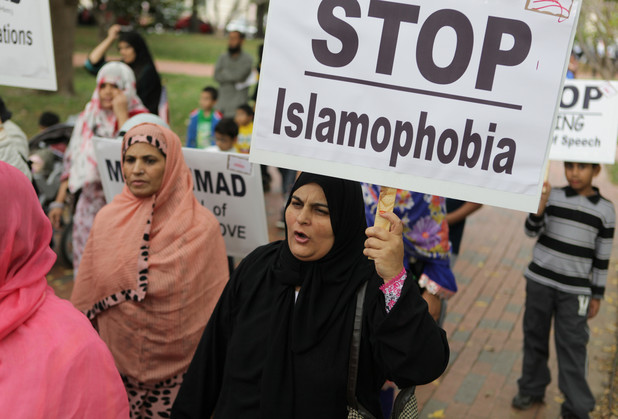
Single Narratives About Terrorist Attacks And Police Shootings

stop-islamophobia

This last week two things coincided: I attended a panel discussion on islamophobia and my facebook friends reacted to the news of Keith Scott being shot by a police officer. These might seem unrelated, but the more I thought about it, the more I realized that these experiences were really about the exact same thing: the human capacity to form narratives and hold on to them. Let’s start with the panel.

Three professors took turns speaking. Their point was that the narrative people have developed about Arabs and Islam is not accurate. People fear Arabs because they’re Muslim. But this is often not the case. There are a lot of Christians, Sikhs, and even agnostic Arabs. And people fear Muslims because of all the terrorist attacks. However, you are much more likely to be killed by lightning than by an Islamic extremist. According to one of the lecturers, Islamic extremism has only killed 109 Americans since September 11th 2001. That might sound like a lot, and every life is precious, but if you run the numbers, there is an infinitesimally small chance that you’ll be one of them. More people die falling out of bed. A lot more: it kills 737 Americans annually. Continue reading

What happens when a liberal professor interviews a conservative economist?

Kevin and Tim.00_53_46_13.Still001

Actually, a surprisingly amiable conversation. We release this fifth Courteous Conversation about minimum wage fittingly on Labor Day. Today celebrates the contribution of laborers—sometimes underpaid and overworked—to our nation’s prosperity and wellbeing.

Continue reading

How to have Courteous Conversations about Polarizing Issues

Video trailer for Courteous Conversations

At the beginning of the summer, David and I set out to find a way to help people who disagree over polarizing issues—even passionately, and often angrily—talk productively together. Fed up with the antagonistic political discourse so prevalent (and aggravated by the current presidential campaign), we wanted to create a situation where people would actually listen to the other side. (For a glimpse into why this kind of conversation is so important, check out this YouTube about political discrimination.) To do this, we had to remove incentives to argue, create a situation where participants felt safe, and take away platforms for rebuttal.

Here’s what we did: Continue reading

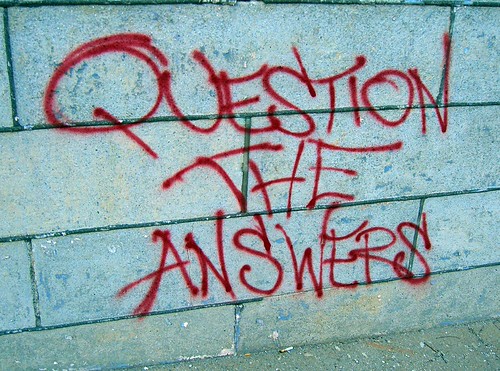
Against Chronological Snobbery: The Lightweight Modern Values of Equality, Tolerance, and Diversity

Question the Answers by walknboston, on Flickr
Photo credit: https://www.flickr.com/photos/walkn/3526522573/

In my last “Against Chronological Snobbery” essay I introduced the debate between the “progressive” view of American history (that America’s history has been one of clear moral progress) and the “non-progressive” view (that it hasn’t—i.e., that the question is at least subject to debate). I endorsed the latter position. Representing the “progressive view” was Justice Kennedy’s Obergefell opinion, together with Justice Marshall’s assertion that the founders lacked any remarkable degree of wisdom, and that the greatness of the Constitution is its more recent embrace of equality and individual rights. Representing the “non-progressive” view was Justice Robert’s dissent in Obergefell and Justice Scalia’s dissent in U.S. v. Virginia, both of which included a scathing rebuke of the majorities’ chronological snobbery.

In this essay, I hope to continue my attack on the “progressive” view by assaulting one of its citadels—the self-satisfaction of contemporary mainstream culture with regard to its own value system.

Continue reading

Why I’m Jealous of Liberals, and What Conservatives Can Do About It

painted hands

I’m jealous of my liberal friends. I’m jealous because they seem to have a corner on the compassion market. Their political representatives champion the poor, minorities, and marginalized, while mine seem intent on invoking Reaganomics and the importance of a balanced budget. Although the economy is fundamentally important, the rhetorical superiority of the liberals should be evident. (Rhetoric 101: When you want to create a following, you should not turn to your accountants for most of the speech material.) It may well be that a more conservative fiscal and economic policy will end up benefiting the most people, but the people, not the policies, should be the focus. As I have written, I tend to believe that conservative principles will ultimately be more beneficial than liberal policies (although I think there are exceptions); however, I find liberal rhetoric much more compelling–it feels more altruistic and mission-driven: Let’s make this a truly equitable country! While equality is not an infallible ideal, it is a powerful rallying cry. Continue reading

“Reductio ad Hitlerum”


I get it. The bad guys in these movies are like the Nazis (that means they must be really bad). Nothing is more frightening to the contemporary Western psyche than the rise of another Hitler. In our mind, Nazi Germany is the quintessence of evil. Although there was undoubtedly evil in the Nazi regime, I wonder if our obsession with Hitler and the Nazis has become unhealthy. Continue reading