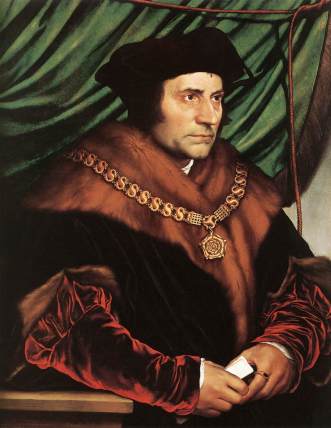
Thomas More, Martyr of Traditional Marriage: Part One—His Greatness and His Values

After watching BYU’s production of “A Man for All Seasons,” a play about Thomas More, I was so inspired that I ordered Peter Ackroyd’s biography of the man. I finally finished it this summer, having worked my slow way through it mostly on Sunday afternoons during the last two years. (Law school has left little time for extra reading.) Although the play “A Man for All Seasons” portrays him, in some ways, more heroically than he deserves, I find that the true facts of his life and death are altogether more inspiring than the play—though I strongly recommend both. (And by the way, the play has been made into an excellent movie of the same title that won six academy awards in 1966, including best picture. Go watch it.) This first essay will be primarily an encomium on Thomas More, though I will depart far enough from my subject to contrast his values with the predominant moral sensibility of our day. In part two, I hope to compare the moral shift that society underwent in More’s day with the shift that has taken place in ours. I have made no secret of the fact that I am opposed to gay “marriage,” and this is part (but only part) of what motivates me to write—for More was, so far as I am aware, the first martyr who can be said to have died, in part, for traditional marriage. Continue reading

Reply to Equality is NOT a False Ideal

lady-justice

Here is my reply:

Thank you so much for your thoughtful response, Rob. Our blog desperately needs dialogue with differing views–both for balance and for interest. And all of us desperately need dialogue with differing views for mere sanity. That said, though, I agree with much of what you say here. But I still maintain that equality should not be considered an end in itself.

My goal with this essay was not to argue that equality is never proper or good or even requisite. It sometimes is all of those things. My goal was to show that it is never the fundamental good that is at issue in any context, and that it is illegitimate to think of it as a fundamental good. My description of it as “a false ideal” may be a little strong, but the strong formulation is intended to grab the attention.

What do I mean by a “fundamental good”? I would say that there are two types of fundamental goods Continue reading

Equality is NOT A False Ideal (Rob’s Response to Brian)

My friend and cousin, Rob Blair, posted this thoughtful rebuttal of my article on Facebook. I repost here with his permission, my response to follow soon. Thank you, Rob!

The “equality of discernment” argument is not one made by any who espouse equality as a political or philosophical value. It is, in my experience, exclusively a straw-man argument, popularized by Ayn Rand.

To say that the race justification of slavery was a secondary evil is problematic. It is that institutionalization that caused continued damage and disadvantage to members of that race. Further, debating which was more evil (the terrible treatment or the way it narrativized an entire race of people in a way that would continue to be destructive to that race in the centuries to come) is rather besides the point. There is no reason we need to choose which one is more important; they are both fundamentally wrong and both deserve attention, consideration, and resolution.

I don’t agree with your premise that equality is not an end to itself. Continue reading

Equality: A False Ideal

FrenchState

“Liberty, equality, fraternity!”: the equality sandwich served up by the French revolutionaries. The outer terms were there mainly because the meat—like the French laborers—needed bread for support. “Equality” seemed to them infinitely more palatable when surrounded by such fine-sounding terms as “liberty” and “fraternity;” airy yet substantial, like a baguette. But the essence of the Revolution was that the Nobles and Royals and Priests were to be pulled down, and the People elevated.

Tastes have changed, and perhaps grossened, since those guillotine days; we now find “equality!” palatable as an entrée unto itself. Most contemporary people seem to take it for granted that equality, in and of itself, is a worthy goal. In our zeal for “equality!” we have eschewed all varieties of discrimination. But some types of discrimination can be a very good thing—for example, the types that are synonymous with “discernment” or “good taste.” Continue reading