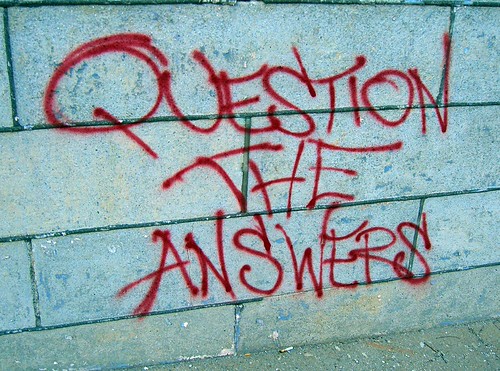
Against Chronological Snobbery: The Lightweight Modern Values of Equality, Tolerance, and Diversity

Question the Answers by walknboston, on Flickr
Photo credit: https://www.flickr.com/photos/walkn/3526522573/

In my last “Against Chronological Snobbery” essay I introduced the debate between the “progressive” view of American history (that America’s history has been one of clear moral progress) and the “non-progressive” view (that it hasn’t—i.e., that the question is at least subject to debate). I endorsed the latter position. Representing the “progressive view” was Justice Kennedy’s Obergefell opinion, together with Justice Marshall’s assertion that the founders lacked any remarkable degree of wisdom, and that the greatness of the Constitution is its more recent embrace of equality and individual rights. Representing the “non-progressive” view was Justice Robert’s dissent in Obergefell and Justice Scalia’s dissent in U.S. v. Virginia, both of which included a scathing rebuke of the majorities’ chronological snobbery.

In this essay, I hope to continue my attack on the “progressive” view by assaulting one of its citadels—the self-satisfaction of contemporary mainstream culture with regard to its own value system.

Continue reading

Freedom to force the artist’s hand

***Adam Balinski is a guest contributor and a friend of Brian’s from BYU Law School. This article was first posted on his blog, rethbo.org. Please visit his blog for more respectful, insightful commentary.***

Some people have jumped on what I think is an incoherent bandwagon that creates crazy consumer rights.

450px-Colorful_three_tiered_wedding_cake_LCP
An uncontroversial wedding cake that the baker could’ve declined to decorate for dislike of flowers or the color pink. photo by tracyhunter

Under federal law, public accommodations are places where consumers go to receive a service. Consumers can’t be kept out of or denied services at public accommodations because of their sex or other protected attributes. (It’s true that under many anti-discrimination laws, sexual orientation is not a protected attribute. But it should be. It’s fair to allow people to go and buy regardless of how they self-identify.) Continue reading

How Romance Taught Me Religion

Wedding_rings

Romance:

Before we were married and while we were still in the midst of determining if we were truly compatible, my girlfriend (now wife) and I came to that brink that all relationships eventually arrive at–when you have progressed as far as you can without either taking the next step together or drifting apart. For us, that next step was marriage. Was she the one? Would our love and happiness last a lifetime? Did we really love each other enough to get married? Was there someone else out there that would be more compatible with me? Continue reading

Thomas More, Martyr of Traditional Marriage: Part One—His Greatness and His Values

After watching BYU’s production of “A Man for All Seasons,” a play about Thomas More, I was so inspired that I ordered Peter Ackroyd’s biography of the man. I finally finished it this summer, having worked my slow way through it mostly on Sunday afternoons during the last two years. (Law school has left little time for extra reading.) Although the play “A Man for All Seasons” portrays him, in some ways, more heroically than he deserves, I find that the true facts of his life and death are altogether more inspiring than the play—though I strongly recommend both. (And by the way, the play has been made into an excellent movie of the same title that won six academy awards in 1966, including best picture. Go watch it.) This first essay will be primarily an encomium on Thomas More, though I will depart far enough from my subject to contrast his values with the predominant moral sensibility of our day. In part two, I hope to compare the moral shift that society underwent in More’s day with the shift that has taken place in ours. I have made no secret of the fact that I am opposed to gay “marriage,” and this is part (but only part) of what motivates me to write—for More was, so far as I am aware, the first martyr who can be said to have died, in part, for traditional marriage. Continue reading

How Should we Study the Bible?

moby

I have recently been working on creating an interfaith and interdisciplinary study Bible with the goal of broadening our approach to the good book. The project would allow readers to gather any relevant video, literature, art, music, et cetera, around passages of scriptures—anything from graffiti to Talmudic commentary. I began the project because I believed and still believe it could be an important step in interfaith dialogue as well as a way to revitalize the Bible from what I believe may be a tragedy of our time: the division of the spiritual and secular worlds. For a thousand years the Bible has been at the center of life, culture, education, art, philosophy, and science. It inspired Dante, Spencer, Milton, Wordsworth, Dickens, and Dostoyevsky to name just a few authors. But now it is increasingly becoming a shield situated between the spiritual self and that dreaded secularization—or the world outside of religion. While this bifurcation helps to maintain Christian identity, I’m not convinced it is the most productive use of scripture. Continue reading