Radical Education Reform: Exhibit A

education football 2.png

This post, a follow up to my previous “opening remarks,” has been a long time coming, but I found myself thinking about the NCAA football championship game, and realized I had stumbled upon “Exhibit A.” Saying that I was thinking about the football game may be misleading: I didn’t know which teams were actually playing, or when the game was until I googled it a few days before it happened. Obviously, I am not really a football fan, but I am generally aware of my alma mater’s team (BYU), and I occasionally watch a game, but I usually stop caring about football when BYU is no longer playing, which tends to be rather early in the post-season schedule. Furthermore, I have never played organized football, but I do participate in “turkey bowls” and other recreational games, although I sometimes wish that we’d play soccer or ultimate frisbee instead. Continue reading

Radical Education Reform: Opening Remarks

The graduating class of 2016 will be underprepared to write at the college level. They will also tend to shy away from STEM careers because of a quasi-collective mathematical incompetence. Something is going wrong. What do we need to change to better prepare these kids for college and careers?

I would be willing to bet that in answering this question, practically every reader automatically began to focus on some problem at the school or classroom level. This seems intuitive: Students aren’t being educated well enough? Fix the schools! To most of us, the entire education system—from the department of education to legislation like No Child Left Behind to the debate about charter schools—is nothing more than the undergirding of the neighborhood school. Schools are where the rubber meets the road. We think education and we think schools.

That just might be our problem. We have conflated education and schooling. Continue reading

Thoughts on Teacher Preparation (Part 2)

The most common conceptualization of what happens when we learn is some version of inputting: We imagine that learning involves taking something located outside of our brain and bringing it inside. Though intuitive, this conceptualization of the learning process is problematic. This is the way that many teachers think about student learning, and it is also the way that teacher preparation programs approach the learning of prospective teacher’s. Indeed, this philosophy of teacher preparation may actually be at the root of our failure to adequately prepare teachers for the demands of the profession. I intend to explain why I think this is so, and offer an alternative model of learning that seems to me less problematic and more promising.

When prospective teachers enroll in a teacher preparation program, usually at a university’s school of education, they take courses where they learn about educational psychology, curriculum design, and teaching methods. All of this is generally interesting and potentially valuable. However, this inputting, though arguably necessary, is not sufficient. Once teachers enter a classroom, Continue reading

Teach for America: When good news is bad

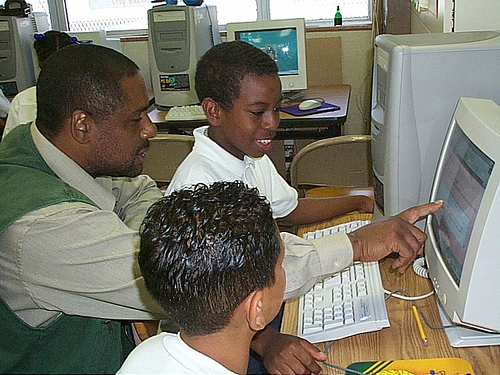
teacher and students

Teach for America (TFA), the teacher-placement and social justice organization venerated by some and maligned by others, is in the news once again. In March, Mathematica Policy Research released a report suggesting that TFA teachers perform just as well as their non-TFA counterparts, which predictably led to polemic commentary. With articles like “Teachers in Teach for America aren’t any better than other teachers” and “Teach for America Passes a Big Test,” writers responded with everything from questions of the validity of the study to “I told you so!”

Although I do have some thoughts about TFA (which I hope to share in future posts), I want to pause for a moment. Continue reading