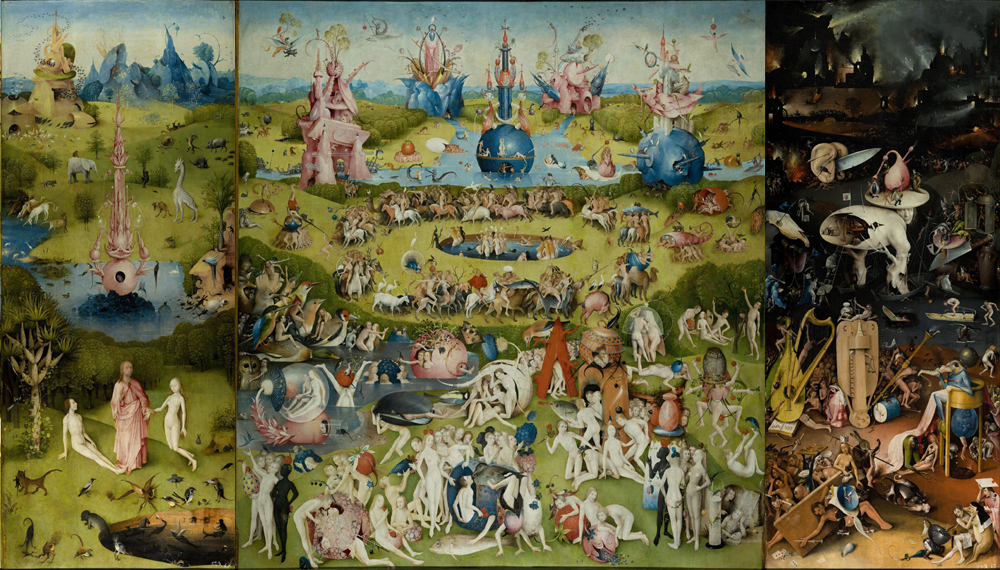
“The World” here is defined in contradistinction to “the Church.” The fundamental difference for present purposes is that the Church recognizes the authority of God’s commandments respecting sex while the World follows its desires regardless of God’s commandments. People do not divide neatly in the World and the Church, but at the same time the distinction is more than theoretical. I am sure that there are atheists who eschew sexual whateverism and, for their own reasons, promote faithfulness within loving dual gendered marriage as the only ethical expression of sexuality; but I cannot think of a single person I actually know who fits this category today. The vast majority of those who remain unmoved by the sexual and ideological revolutions of the last century are the religious–and most major religions (including at least Hinduism, Christianity, Islam, Sikhism, and Judaism) have historically spoken with virtual unanimity on the subject. Buddhism, of course, considers liberation from all desire and attachment the ultimate goal, and it therefore has perhaps an even less permissive stance towards sexuality than the other major religions.
While the nearly unanimous consensus of the world’s major religions is so strong an argument in favor of traditional sexual morality as to be, in my judgment, very nearly conclusive, I do not insist on traditional sexual morality for present purposes. What I insist on is that people must attempt to comply with a moral and philosophical system that is dictated by reason and conscience and not by desire. Desire must bow to Right (“as God gives us to see the right”), not Right to Desire. To the extent that a rigorous and conscientious atheist regulates his sexuality by the morality that seems to him correct and yet denies the authority of God’s purported commandments, he is outside the Church but also outside the World. Continue reading →
Our actual experience of sexuality is full of ambiguities. There are at least three major sources of ambiguity that I can discern:
The gap between reproduction itself and the bodily and mental processes associated with reproduction.
The slippage inherent in language.
Differing world views and philosophies of sexuality.
There can be no serious claim that sexuality lacks ambiguity, because intelligent people and cultures interpret it so differently. I am not an anthropologist, but I know just enough to know that anthropology furnishes precious few universals across cultures within the realm of sexuality. The few that do exist, according to Wikipedia’s page on cultural universals, include a prohibition on incest, some form of cultural dress code (sexual modesty is described as a “cultural universal” here), and some form of marriage. Continue reading →
There are several reasons that I am an attorney instead of an English professor (my original plan). A relatively minor reason that I don’t usually mention is the dominance of multiculturalism in the academy as a lens for talking about and judging literature and culture generally.
What I mean by “multiculturalism” is a particular kind of intense focus on race, gender, class, nationality, sexuality, and other categories that might make a person a minority, and the ways in which cultures construct and deploy these categories (generally in ways that disadvantage the minority). Anyone who has studied English literature at today’s universities should understand what I mean. But so should anybody familiar with the rhetoric of certain liberal politicians, some of whom (for instance) have recently assumed it unnecessary to make any substantial explanation of why they deem it deeply wrong for Joe Biden to have had collegial relationships with segregationist senators. Continue reading →
You have expressed, by your words and/or your actions, that you feel no need to go to church. You don’t see how it would benefit you and your family (as I believe it would). I appreciate the frankness with which you shared how you feel, and I will also be frank even though that will entail explaining why I think you should feel differently than you do. In explaining this, I want to be clear that I don’t think you are a bad person for thinking as you do. But I do think you are mistaken on this point, and I consider it a point of sufficient importance that I want to explain why I think so.
On my mission in Taiwan and since then, I have met many people who have said they don’t see the need for church even though they believe in God. Many of these have told me something to the effect of “I’m happy with where my relationship with God is right now.” And if this is what they sincerely think, rather than glibly saying it to brush aside the matter, then I think it is their first and greatest error. Continue reading →
To many modern minds, including the minds of most people my age (thirties) in the Western world, it is practically inconceivable that there might be any legitimate rationale for inculcating a preference for heterosexual marriage over any other expression of sexuality, including homosexual marriage. This preference is the historical status quo, but it has been so dramatically rejected in the last 75 years (and especially the last 15) that, for many today, the whole business of disapproving sex for any reason other than nonconsent is wholly alien, bizarre, and even evil–a thing to be dismissed with a word: “Victorian,” “repressive,” “culturally insensitive,” etc. But can it be so easily dismissed? Where did the tradition of disapproving expressions of homosexuality come from?
Is it, as many moderns imagine, entirely irrational, evil, and indefensible? Continue reading →
It is debatable whether more ink or blood has been spilled throughout history over disagreements about the nature of scripture. The greatest expenditure occurred during the Reformation, but the rise of the Church of Jesus Christ of Latter-day Saints also resulted in a substantial outflowing. And yet the issue has never been settled, either amongst the denominations or within any single church. In addressing this subject in our age, I need not fear violence, but I fear I may not hope for many readers either.
There is much to love about the Church of Jesus Christ of Latter-day Saints, not the least of which is its unique take on scripture. We believe the scriptures to be the word of God in a sense not entirely pinned down, but we do not believe in scriptural infallibility. From this perspective, church members should be free to appreciate the scriptures in a relatively free and broad-minded manner. Yet we tend to slip into the habit of reading our scriptures as if the main point was simply to set forth true doctrine (i.e., “Mormon doctrine”–what we already believe and understand)–as if the scriptures reached no higher and probed no deeper than the Gospel Principles manual. Without denigrating the eternally important purpose of teaching true doctrine, I hope to set forth other aspects of scripture to encourage a less dogmatic approach that is both richer and truer to the text. Stay tuned over the next week or two for a series of posts highlighting what scripture is besides doctrinal instruction, starting with art.
Scripture as Art: A God Who Puns
Among scholars of scripture, the claim that scripture is art must be one of the few uncontroversial claims. Whatever else it is, whatever more than art, it is certainly not less than art. The canonical words of the Bible and Book of Mormon come down to us in the particular art forms and genres that developed in the ancient Hebrew culture; the great sections of the Doctrine and Covenants are stamped with a wonderful conglomerate style that mingles two of the literary high points of English prose–King James’s reign and the mid-19th century.
Part of the reason we tend to miss the artistic aspect of scripture is that some of it is lost in translation. “Thou are Peter, and upon this rock I will build my church.” The Greek word “petros” (rock) made this statement a pun. This is one of the better known instances, but punning and word play is found throughout the Old and New Testaments. Few of them translate into English. Nor would any use of meter, consonance, assonance, alliteration, onomatopoeia, etc.
But though we lack direct access to the original sounds that the original authors used to aesthetic advantage, we are still without excuse if we fail to recognize scripture as art. Many of Jesus’s parables are perfectly constructed gems from a purely aesthetic perspective, leaving aside their truth and moral power. Much of the prophetic writing in the Old Testament is in verse (though the King James translation fails to capture this fact). And while much of the aesthetic flourishes of scripture do not translate, some do. When Jesus told Peter, “I say unto you, not until seven times, but until seventy times seven,” the wordplay here translates pretty well. The word “times” in English evidently corresponds with the original language’s word. Both carry the related meanings of “instances” and “multiplied by.” Both cultures used a base-10 system of counting so that “seven” correlates with “seventy.”
Note that if Jesus had intended merely to express clearly and unambiguously the actual doctrine, he would have simply said, “always forgive” or some such statement. His use of aesthetic flourishes actually risks obscuring his meaning for a people who seemed to take everything he said literally. So why did he not adapt himself to their weakness and speak in plain, unmistakeable prose? There are no doubt many good answers to this question, but my main point here is not to address the why of it, but just the fact itself: the scriptures bespeak a God who is alive to the richness and play of language, and who sometimes prefers a good pun or an ambiguous story, that he may express his meaning (or meanings) in a manner pleasing to the sense, tractable to the memory, and demanding of the intellect. Because of this, scripture requires, even more than most texts, an interpretive act whereby we put something of ourselves into the text.
Next: Scripture as Myth: A God Who Comes Alive Again




 The Brothers Sabey
