How Romance Taught Me Religion

Wedding_rings

Romance:

Before we were married and while we were still in the midst of determining if we were truly compatible, my girlfriend (now wife) and I came to that brink that all relationships eventually arrive at–when you have progressed as far as you can without either taking the next step together or drifting apart. For us, that next step was marriage. Was she the one? Would our love and happiness last a lifetime? Did we really love each other enough to get married? Was there someone else out there that would be more compatible with me? Continue reading

Dear Presidential Candidate – I believe in the Constitutional Convention

Dear Presidential Candidate,

I watched the Republican debate earlier this month. Their rhetoric (like that of other parties) often riffs on the claim, “I believe in the Constitution.” What that actually means is somewhat harder to express in a soundbite. As with all historical texts, our understanding of what it means is not as straightforward as we might like to think—it is based on conjecture of authorial intent, interpretation of judicial precedent, and appeals to implicit ideals. This is not to say that we should ignore the actual text of Constitution, but I think recognizing the complexity of constitutional law can help us tolerate and even collaborate with those who interpret it differently. Continue reading

Thoughts on Teacher Preparation (Part 2)

The most common conceptualization of what happens when we learn is some version of inputting: We imagine that learning involves taking something located outside of our brain and bringing it inside. Though intuitive, this conceptualization of the learning process is problematic. This is the way that many teachers think about student learning, and it is also the way that teacher preparation programs approach the learning of prospective teacher’s. Indeed, this philosophy of teacher preparation may actually be at the root of our failure to adequately prepare teachers for the demands of the profession. I intend to explain why I think this is so, and offer an alternative model of learning that seems to me less problematic and more promising.

When prospective teachers enroll in a teacher preparation program, usually at a university’s school of education, they take courses where they learn about educational psychology, curriculum design, and teaching methods. All of this is generally interesting and potentially valuable. However, this inputting, though arguably necessary, is not sufficient. Once teachers enter a classroom, Continue reading

Teach for America: When good news is bad

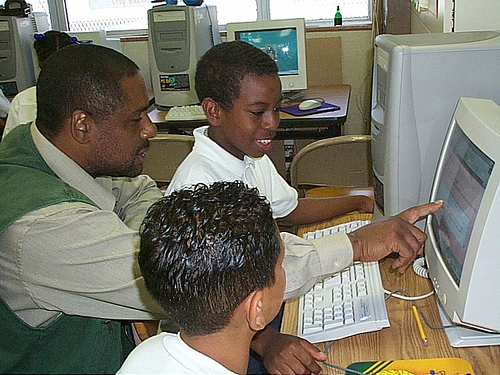
teacher and students

Teach for America (TFA), the teacher-placement and social justice organization venerated by some and maligned by others, is in the news once again. In March, Mathematica Policy Research released a report suggesting that TFA teachers perform just as well as their non-TFA counterparts, which predictably led to polemic commentary. With articles like “Teachers in Teach for America aren’t any better than other teachers” and “Teach for America Passes a Big Test,” writers responded with everything from questions of the validity of the study to “I told you so!”

Although I do have some thoughts about TFA (which I hope to share in future posts), I want to pause for a moment. Continue reading