
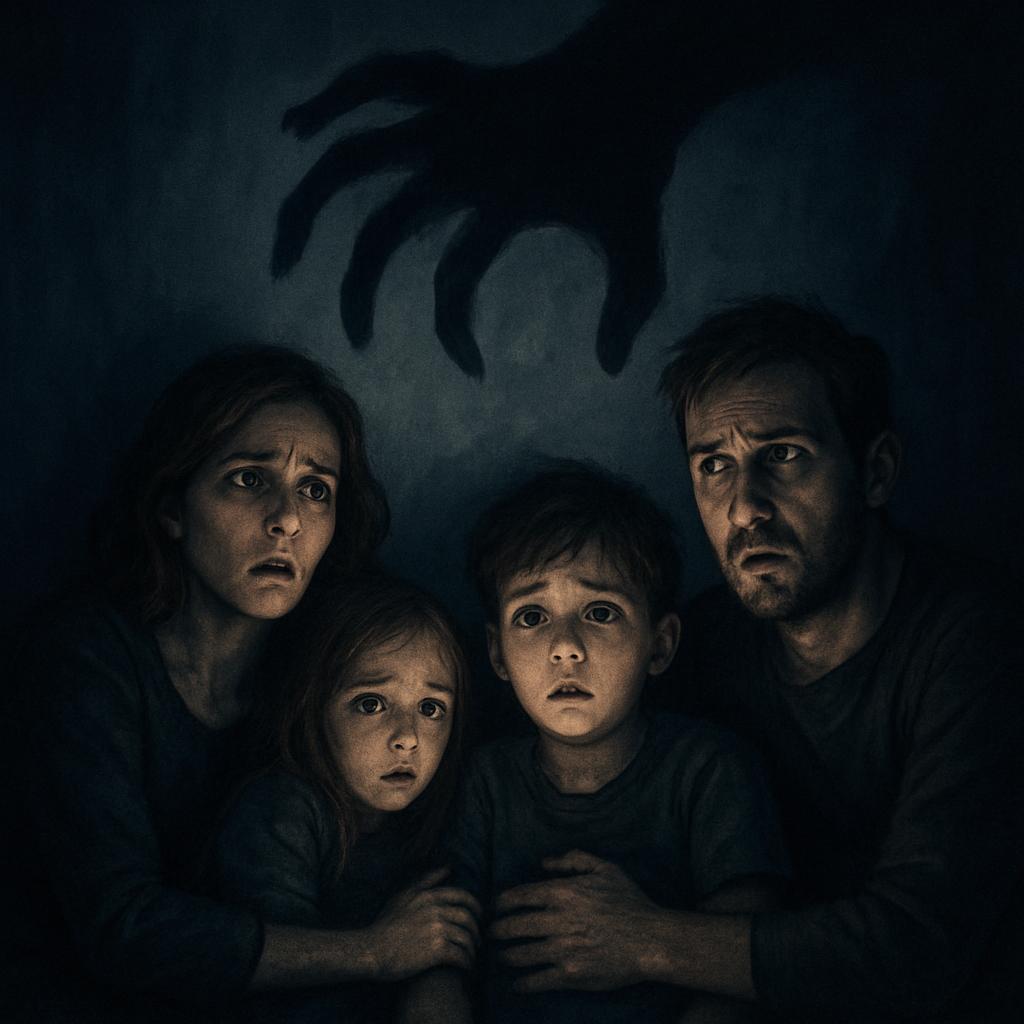
On May 27, 2025, Judge Vance dismissed criminal charges against me and closed the case on my criminal negligence child abuse prosecution. My crime? Failing to notice that my toddler, Miriam, had snuck away from the van while I was buckling in the crying baby, inadvertently leaving the toddler at the park, and driving home (at which point I noticed she was not present). She was absent from me for roughly 20 minutes before I had rushed back to the scene. By then, two well-meaning women had found her crying at the roadside and called 911.
When I arrived, the policeman had been there for a few minutes, talked with the women, and made a report of some kind. I could see him figuratively cracking his knuckles when I got out of my car to collect the child. He instructed me that I could buckle Miriam into her car seat and then he wanted to talk to me. In other words, I was not free to go. I assumed that the questioning was to determine whether a report to Child Protection Services was warranted. I had no idea I was being investigated for a crime, because I had no idea–and it still boggles my mind–that an honest small-caliber mistake by a dad that did not actually result in any harm to the child or anyone else would be construed as child abuse. I was not read my rights (even though I was not free to go and was therefore in police custody), which would have disabused my naivety.
At one point, the officer commented on the size of my van. (We call it the “Levia-van,” a play on “Leviathan.”) I explained that I had seven children. He smiled and said, “Seven children?! You have your hands full!” (If I had a penny for every time someone informed me that my hands were full…) And then an interesting thing happened. I could see, in his face and demeanor, that this new piece of information had brought him to a decision point: laugh this off as understandable in light of how full my hands were, or continue pursuing the course he was on of treating my error as a malfeasance that needed to be addressed through the power of the state. In a moment, he chose the latter–his face returned to grimness, and he said, “Well, all the more reason to make sure you keep track of them all.”
He ended up calling in two additional police officers to watch me while he filled out paperwork or whatever it is they do before presenting you with a ticket. The backup officers yelled at me when I began to reach into the center console of the van for a snack for the toddler. We exchanged explanations: I reached for a snack; they yelled because people in “this kind of situation” can do stupid things, like reaching for guns. The original officer finally presented me with a ticket for misdemeanor child abuse. By this time, I was expecting a ticket, but I thought the charge would be something more innocuous, like “carelessly causing 911 to be called” or whatever petty crime corresponds to that concept . I looked at him with shock, and I think he saw accusation in my face, because he next spoke with a tone of self-justification and reciprocal accusation: “I’ll tell you why. I’m wrote you a ticket for child abuse because this two-year-old was by herself, crying, alone on the street for 20 minutes. And I could have you arrested.” With that, he dismissed me: I was no longer in police custody, free to take Miriam home.
A few days later, we got a call from Child Protection Services. They wanted to schedule a visit. We were in the middle of a little construction project–finishing an addition to the house–and all work stopped so that we could prepare for the CPS visit. This was immensely stressful for us, not least because just a couple of years ago, two nephews had been removed from their home by CPS after the baby was taken to the emergency room for a severe cold. A chest x-ray (checking for pneumonia) revealed two mostly healed, but initially unexplained, rib fractures within the space of a thumbprint, from a single injury. The received wisdom, supported by medical studies that, by their own admission, are methodologically unsound, is that unexplained rib injuries in babies are usually caused by abuse. Many sleepless nights and many thousands of dollars in legal bills later, my brother and sister-in-law had full custody restored. During that time, they learned about an innocuous circumstance that likely explained the injury, involving a grandparent urgently and forcefully grasping the infant to prevent him falling the rest of the way out of his car seat. When this explanation was given to CPS, they shifted even more than they already had into CYA mode. They have never admitted fault and continue to maintain that the injury was caused by abuse. In the process, they asked the court to issue a gag order to prevent my brother and sister-in-law from telling the press their story.
Having had two nephews removed from their home on so slight a basis, it was terrifying for us to have CPS coming to investigate us. We deep-cleaned the house and yard, installed safety features, got rid of the scrap heap at the side of the yard, finished the fence so the backyard would be fully enclosed, and moved some children into different bedrooms based on CPS guidance my mom found online that apparently holds that boys and girls over the age of 4 should not sleep in the same room. Some of the changes were good, some were useless, and some were worse than useless, but all of them were mainly intended to make the house appear safe from CPS’s arguably distorted perspective. The goal: minimize the likelihood that CPS would consider it necessary to make a second visit, both for our peace of mind and for the safety of our family.
The CPS visit was a total non-event–as we mostly expected, despite our days of intensive preparation. They as much as announced that they recognized this was a mistake, and parents are allowed to make mistakes. They had no concerns, and would complete their report with no further actions expected.
Meanwhile, I had been agonizing about whether to hire a Criminal Defense attorney to help me navigate the child abuse charges. I ultimately decided to wait until I knew what initial plea deal I would be offered before spending thousands of dollars on a lawyer, and this proved to be a good choice. I appeared in court on the day specified on the ticket, and the judge confirmed that I was accused of child abuse based on criminal negligence. I received an initial plea offer a few days later: the charges would be dropped in exchange for completing a parenting class. I completed a parenting class. It was utterly useless. But I was grateful to have the charges dropped. However, in a fully sane society, in my opinion, the charges would have been dropped without conditions.
Eventually, it all blew over with no major lasting repercussions, so far at least, but only after dozens of hours of needless work, weeks of extra stress, and unmeasured fear and trauma, all of which was totally unnecessary.
Having seen the darker side of CPS through my nephews’ experience, and having now taken a parenting class, I am quite skeptical that any intervention available to the state short of removing children is likely to make a significant difference, and I am even more skeptical about the removal of children: while I acknowledge that this can be and sometimes has been a good thing, I believe the evidence suggests that on average, removals are more harmful than helpful. Doyle JJ. Child Protection and Child Outcomes: Measuring the Effects of Foster Care. Am Econ Rev. 2007 Dec.; 97(5):1583-610. If I am right–that nothing short of removal is likely to make a difference, and removal usually harms more than it helps–then it seems that the world would be better without CPS.
But you do not need to share my CPS skepticism to recognize that treating honest mistakes and momentary neglect by committed parents as crimes is harmful, wasteful, and counterproductive. It creates fear and mistrust towards the police, CPS, and other institutions of governmental oversight and control. It guarantees, for example, that I will be very hesitant to call the police if I ever find a lost child, because I assume they will not confine themselves to the helpful role of reconnecting a distressed child to their distressed parents, but will instead inflict significant trauma and harm on another family, as they have done to mine.
Also, treating such errors as crimes effectively criminalizes large families. Every time I tell this story to anybody I know who has a large family or comes from one, they invariably share a time that they or a sibling or a child of theirs was left somewhere. With seven children, it is inevitable that not every child can be attended to adequately at all times. I hasten to add that I firmly believe that the heightened risk of accidents that I am admitting exists with many children is more than compensated for by the blessings of large families, including the usually lifelong sibling relationships that studies have shown to be beneficial. But as a father of seven, I believe that I should be able to view the state as a source of encouragement and support, rather than of condemnation and danger.
To those who believe I am taking my opinion of CPS too far, you may be right, but I would say this: there will always be some who dogmatically believe in small government and others who dogmatically believe in big government, but there are also many who wish to base their judgments about the ability of the state to exercise power in a benevolent manner on actual evidence. If you are in favor of policies that imply that the state can and should be entrusted with the massive powers of regulation and surveillance that it currently wields, then your first concern should be to ensure that abuses of this power are detected and stopped, or those abuses will sink your policy preferences in the eyes of reasonable citizens. In this case, both the CPS investigators and the prosecution were fairly reasonable. It was the police who were unreasonable, though I suspect CPS involvement by phone with the officer. But even though it ended without any serious and lasting harm, absolutely nothing good came out of this ordeal, apart from some minor home improvement projects and a touching show of support by our close friends and family. Yet the state expended very substantial resources through at least four agencies: the police, CPS, the court, and the district attorney’s office. In a political environment where budgets are stretched beyond the breaking point and governmental waste is a rallying cry, such expenditures are suicidal.
Interestingly, the three-month period during which this ordeal played out corresponded almost exactly to my once-a-quarter book club’s reading of The Anxious Generation, by Jonathan Haidt. He has a lot of very important points to make about the shifts in parenting and in childhood during the last forty years. One of his main points is, “We decided that the real world was so full of dangers that children should not be allowed to explore it without adult supervision, even though the risks to children from crime, violence, drunk drivers, and most other sources have dropped steeply since the 1990s.” This, he thinks, has been a serious error, with serious consequences. Among other reasons, he asserts that children are not just resilient, but actually “antifragile”: psychologically, they require stresses and risks and freedom to explore and scrape up their knees to become as robustly healthy as they can be. As a result, optimal parenting includes allowing kids the freedom to roam about unsupervised as soon as they are old enough to do so, and this also entails the freedom to engage in risky play (e.g., climbing trees). Yet both the parenting laws and the parenting culture that have developed during recent generations are antagonistic to this developmentally useful freedom.
The number one reason for these cultural shifts is “the breakdown of adult solidarity.” Haidt argues that the historical default has always been that adults, even strangers, will help out children in trouble, and are expected to do so. But in the 1980s and 90s, increasing awareness of child abuse by non-parents, sometimes caused by fake news, created a false perception of risk and a rising sense of “stranger danger” between adults. This ultimately caused a new norm of leaving children that are not one’s own alone. “But when adults step away and stop helping each other to raise children, parents find themselves on their own. Parenting becomes harder, more fear-ridden, and more time consuming, especially for women[.]” (The Anxious Generation, p. 87).
Of particular relevance, Haidt references a study in the Social Policy Report that concludes that the way current U.S. child neglect laws are written and interpreted is generally not evidence-based and is full of vagueness and ambiguity. This creates a risk of prosecution for what is actually optimal parenting. Along these lines, he states:
The Social Policy Report essay notes, “Parents who fail to provide their children opportunities for physical and cognitive stimulation through independent activities are potentially ‘neglecting’ their children in those dimensions.” So a lack of adult supervision should not be the touchstone for a neglect finding. In fact, maybe the state is engaging in neglect when it mandates overprotection.
(The Anxious Generation, p. 241)
Now, I am not claiming, and Jonathan Haidt presumably would not argue, that it was age-appropriate freedom for my two-and-a-half year old to remain at the park by herself for 20 minutes. That was an accident, and it was traumatic for everyone involved. But Haidt’s argument is still relevant, because the perception that what happened was a crime is, I believe, the direct result of the same social shifts that have caused overprotection to be arguably legally mandated. In a world where it is criminal to knowingly let your nine-year-old ride the subway without supervision (The Anxious Generation, p. 240), it also becomes criminal to accidentally leave your toddler at the park. Such a world inevitably contains dozens of subtle disincentives against large families, which I see as profoundly negative. Can anyone doubt that, had this happened 50 years ago, there would have been no severe repercussions? What changed since then? The answer, I urge, is not that we changed due to new evidence but rather that we have caved into various unreasonable and ultimately harmful trends: overprotection, parental perfectionism, and loss of social solidarity and trust, among others.
While I would not claim that it was a good thing for me to inadvertently leave Miriam, I would say that the actual risk of any serious injury or accident was fairly low: while the circumstance was negative, it was not a profoundly bad thing, even as accidents go. And I would go so far as to say that we should admire and emulate the Japanese tradition of “The First Errand” as documented in the Netflix TV show “Old Enough!” and the Apple TV show “Becoming You,” where children, sometimes even younger than Miriam, are given an errand, such as buying something at the grocery store, that requires them to leave their home, move through public spaces, and interact with strangers. This is a first coming-of-age ritual that shows that, so far at least, public trust and adult solidarity has not deteriorated as much in Japan as it has in our society.
I have expressed skepticism about the value of CPS, but in fairness, so far as I know, it was not CPS that caused the waste and trauma of which I complain. It was the police. CPS is only the profound symbol and embodiment of the surveillance state’s attempts to intervene in family life. But my story suggests some cause for hope. While I believe it was a profound and costly error for the police to treat what happened as a crime, everything else worked out mostly as it should. The two women attempted to take care of the crying child at the side of the road, confirming that, contrary to the current trend in adult perceptions, we can still mostly trust other adults to help protect and guide children if they feel at liberty to do so. I promptly realized I had left Miriam at the park after arriving home, and immediately returned for her. The CPS investigators recognized that there was no cause for further involvement. The prosecutor likewise recognized that taking a hardline in this case would be inappropriate. But my story also demonstrates serious cause for concern. The justice system, the police force, and our society as a whole has gotten its priorities seriously wrong, drinking the Kool Aid of overprotection and criminalization of innocent parenting accidents and even of developmentally optimal risk-tolerance, intervening dozens or hundreds of times each day in situations that are better left untouched by the state. As a concerned citizen who has now been made a victim of these perverse trends, I would urge citizens, lawmakers, and leaders of the involved agencies to consider what can be done to correct them.
 The Brothers Sabey