
Tell all the truth but tell it slant —
Success in Circuit lies
Too bright for our infirm Delight
The Truth’s superb surprise
As Lightning to the Children eased
With explanation kind
The Truth must dazzle gradually
Or every man be blind —
-Emily Dickinson
I participate in a theology book club in which we are reading Exploring Mormon Thought, by Blake Osler. Osler is interesting in that he is doing systematic theology, but at the same time he questions the value of systematic theology, doubts its ability to attain its own goals, and admits the limitations of language and the necessity of experiential and relational knowledge in spiritual matters, in contrast to propositional beliefs.
I agree with his questions, doubts, and admissions. I appreciate his work and consider it worthy of our time and attention, but I could be just as good a Christian without once cracking a book of systematic theology.
Now I want to be clear that I am fully in favor of careful thought and intellectual rigor, of seeking greater and greater light and knowledge. Indeed, doing so is a spiritual necessity. If our light and knowledge is not growing, it is shrinking (see Alma 12). Far more than most brands of traditional Christianity, LDS thought enjoins intellectual effort as a duty: we are commanded to “seek out of the best books words of wisdom” and informed that we cannot be saved in ignorance. My target here is not intellectual effort or even theological carefulness, but solely systematic theology.
What is the difference in my mind between theological carefulness, the value of which I affirm, and systematic theology, the value of which I doubt? The difference is precisely the systematic nature of systematic theology. It seems to me a great presumption for anyone to claim that they have a firm enough grasp on reality and a sufficiently complete understanding of God’s revelations that they can describe in a systematic way how it all fits together. Such an effort, it seems to me, will inevitably lead to distortions. In attempting to seamlessly weld it all together, some things will be over-simplified, while other things will be over-complicated. The whole map will be off, and not just at the wide-stretched poles. Might it even be better not to make the attempt, I wonder?–better to hold tensions and contrasting possibilities in one’s mind and reserve judgment even as we pray and study our way towards deeper comprehension? Better, perhaps, to study the “best books” and devote our efforts to celebrating goodness and beauty and teaching truth “slant” in essays, poems, parables, novels, paintings, or devotionals, etc., rather than attempting to summarize the whole in a multi-volume work?
Certainly, if we had to choose, it would be far better to celebrate goodness and beauty and focus on BEING true than to spend our time FINDING propositional truth.
I write this with a great deal of hypocrisy. In practice, I unfortunately seem to have these priorities backwards. I am an extremely curious person, and I would rather read about political or philosophical controversies than work on my church assignments. I tend to procrastinate duties so as to pursue interests. In this, I think I’m very average. And perhaps this is the best defense for systematic theology: while all would probably admit it is unessential for discipleship, systematic theology is better than unsystematic theology. Since most of us are quicker to wonder about Jesus than to follow him, we might as well wonder in a productive and disciplined fashion.
But let me return to my claim that systematic theology will inevitably involve significant distortions. Here is an example from Ostler. In summarizing the teachings of the lectures on Faith regarding the properties of God that are necessary to justify faith unto salvation, Ostler writes:
Faith also requires that God have knowledge of “all things, from the beginning to the end.” Without the belief that God knows all things, we could not trust him to save us, for without such knowledge he could not impart an understanding to us by which we have eternal life. However, the Lectures wisely refrain from saying whether the “things” that God knows includes items which are not yet in existence and therefore not yet truly “things.” If God knows all “things,” but the future does not yet contain any “things” to be known, then God need not know the future, in this view of God’s knowledge.
This passage is, in my opinion, a fine bit of well-meaning sophistry. The most natural reading of knowing “all things from the beginning to the end” is that God knows the past and the future perfectly. Ostler wishes to avoid this reading, because it does not fit into his philosophies of time, causality, and “libertarian free will.” So he provides a different interpretation by suggesting that “things” could be defined to exclude that which does not yet exist. The problem with this move is that it fails to provide any consistent interpretation for what knowing ALL things from the beginning to the end could possibly mean if God does not know the future. Osler’s interpretation seems to be that God knows the ultimate ending of the story of creation, because he presently intends to cause it to be so and has sufficient power to fulfill his intention. But this is not a consistent reading of the language in question. If God knows the ending of the story because he is going to cause it, and that is what is meant by the assertion that God knows “the end,” then clearly, while he does know something about “the end” (i.e, the future), he does not know “all things.“
This is a fairly straightforward example of distortion, and a very minor one, since it deals with the interpretation of no longer canonical language, and takes a legitimate position with regard to the nature of God‘s foreknowledge, fudging merely by claiming that his position is consistent with the lecture in question. Yet Osler‘s philosophy of time and freedom functions as a limiting premise that all the rest of his system must filter through, or at least be consistent with. And I believe this becomes a source of distortion with regard to the entire picture, not just the interpretation of one lecture.
I believe that God functions both in time and in eternity. This, I believe, is the clear testimony of scripture. Eternity is something different from time. I believe, with Kant, that human cognition is a priori temporal, meaning that we can only have any perception or cognition or thought or experience through the mental filter of time, which is an intuition hardwired into our minds. He claims that this pure intuition of time may or may not reflect how things are in themselves, but it is the only way we can experience them. Everything that reaches the human mind has always already been filtered through (among other Kantian categories) time. If Kant and I are correct about this (perhaps a big if), then it follows that we can have no comprehension of anything that is atemporal. Eternity, for us, can only be conceived in temporal terms. And therefore we generally think of eternity simply as time extended endlessly into the past and into the future. Given our mental apparatus, we have no other option. Yet the scriptures, especially the Doctrine and Covenants, constantly refer to eternity in contrast to time itself: the exact phrase ”in time and in eternity” appears three times in the Doctrine and Covenants, and the idea of time itself contrasting with eternity appears many more times, there and elsewhere.
Until we can actually comprehend what God means when he says that he is in the “bosom of eternity”–which I think cannot happen until our mental apparatus are upgraded–we should not, in my opinion, make any pronouncements about how God‘s foreknowledge might or might not be consistent with human freedom, or whether Jesus was somehow able to experience the sin and suffering of people yet unborn.
And this word, “consistent,” is what I think.mainly rubs me the wrong way about systematic theology. Self-consistency is what makes systematic theology systematic. Now, I too prize consistency, to be clear. I merely maintain that we are in no position to attain it, and we ought to persist in wrestling, reverently and meekly, with contradictions rather than to prematurely set down axioms and deductions and conclusions, especially if they have any pretension to comprehensiveness.
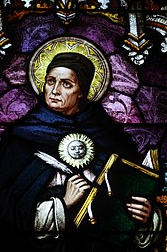
I recall reading in my philosophy textbook (The Great Conversation), and later discussing in a philosophy class at BYU, the fact that an apparent mystical vision put an end to Aquinas’s theological career.
Having returned to Italy after Easter of 1272, Friar Thomas took part in the General Chapter of the Order, at Florence, and then he went to Naples again to continue his teaching there. One day, December 6, 1273, while he was celebrating Mass in the chapel of Saint Nicholas, a great change came over him. From that moment he ceased writing and dictating. Was the Summa then, with its thirty-eight treatises, its three thousand articles and ten thousand objections, to remain unfinished? As Reginald was complaining about it, his master said to him, “I can do no more.” But the other was insistent. “Reginald, I can do no more; such things have been revealed to me that all that I have written seems to me as so much straw. Now, I await the end of my life after that of my works.”
Maritain, St. Thomas Aquinas, Meridian Books, 1958, p. 54.
He wrote nothing more until his death on March 7, 1274, leaving his Summa Theologica unfinished. As he lay on his deathbed, however, after repeated requests by the monks of Fossanova Abbey, he consented to dictate commentary on the Song of Solomon. The dictation is no longer extant.
That the “angelic doctor” died in that place giving commentary on the “Song of Songs” became ever after a badge of honor for the abbey. Engraved in latin on the altarpiece of the abbot’s chapel is the following, which I find touching in itself as well as fitting as a conclusion to this essay, as it beautifully encapsulates the turning of the arch-systematizer from what I take to be a lower pursuit to a higher.
That by praising he might die and that by dying he might praise, Thomas expounded the Song of Songs upon being asked to do so by the monks of Fossanova. He was carried off to heaven by the power of love that is greater than the power of death.
https://thomistica.net/st-thomas-last-days.
 The Brothers Sabey